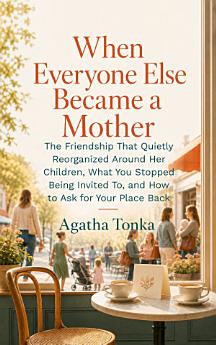
When Everyone Else Became a Mother: The Friendship That Quietly Reorganized Around Her Children, What You Stopped Being Invited To, and How to Ask for Your Place Back
About this ebook
Scroll up in the thread with her name at the top and find the last real plan. A Thursday dinner, or the Saturday grocery run you used to do side by side. You never agreed to stop. Now dinner moves twice around a nap schedule, the long Sunday calls circle back to daycare, and every visit ends with her saying the two of you have to do a proper evening soon. Nothing ever reaches the calendar. Then one afternoon she slides her phone across the kitchen island to show you her new porch light, and her thumb scrolls past a lake house weekend that you never heard about.
When Everyone Else Became a Mother is for the woman whose friendship quietly reorganized around a friend's children. Agatha Tonka writes it without a villain. Your friend is tired in a way you may never have lived through, and you are lonely in a way she has not noticed. The book keeps apart lives that usually get folded together: women who are childfree by choice, women who are childless and grieving it, women still trying after a pregnancy loss, and mothers whose version of motherhood did not fit hers. It also stays for the hardest sentence, when she turns from the stove and says you have no idea what her life is like.
Then comes the work. For six weeks you keep a reciprocity record of who reached out and whose schedule set each plan. You learn what that record cannot see, like a mother in and out of the hospital all through May. Chapter Fourteen walks through drafting one small request in the notes app, far from the thread, and send it at a moment you chose. Some friendships adapt into evening laps around a muddy soccer field with a stroller. Others will not, and the book is honest about that limit, then turns to building belonging outside the old group, in a week with enough places where you are expected.
Agatha tells you up front that she uses almost no statistics, because many of the numbers about losing friends after a baby fall apart once you trace where they came from. The few studies she names are listed at the back with what each one cannot support.
This book offers reflection and practical steps for adult friendship, and it is not therapy.
Discover more
About the author
Agatha Tonka writes about the interior life of women who are managing more than anyone has noticed. Her subject is the ordinary, unannounced arrangement that forms around a capable woman without her ever agreeing to it, and the particular loneliness of being assumed to be fine because you have never said otherwise. She writes about the conversation that does not happen, the request that never gets made, the accommodation that becomes a baseline, and the moment somebody finally works out what has been going on and has to decide what to do about it. She does not write about villains, because in her experience there usually is not one, and a book that supplies one is a book that lets its reader off the harder and more useful question. She writes for the woman reading at the end of a long day, who wants to be told the truth plainly and does not want to be flattered.