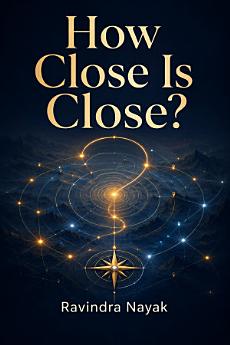
HOW CLOSE IS CLOSE?
この電子書籍について
A key can be close to another key on a table but far away in purpose. Two songs can share a rhythm and still feel completely different. Two search results can receive similar scores while only one answers the question you actually asked. Modern digital systems make comparisons like these constantly—when they search, recommend, group, rank, retrieve, or decide what should appear next.
How Close Is Close? begins before the formulas. It asks the question that makes every formula meaningful: close in what space, according to which features, for what purpose?
Written for non-technical readers, this book builds similarity from first principles using ordinary objects, clear diagrams, Mira-and-Kabir dialogue, physical experiments, small numerical examples, and practical thinking exercises. You will see why representation comes before distance, why units and feature scale can quietly change a result, and why the nearest neighbor is not automatically a useful neighbor.
Step by step, the book develops the ideas behind absolute difference, straight-line and grid-step distance, normalization, feature weighting, angle-based similarity, nearest neighbors, clustering, high-dimensional spaces, thresholds, ranking, retrieval, recommendation, precision, recall, and evaluation. The mathematics is introduced only when it earns its place, and every compact formula is returned to an ordinary-language meaning.
The journey then moves beyond calculation. Search and recommendation systems must serve a purpose, not merely maximize a similarity score. A result can be mathematically near but practically irrelevant. A ranked list can contain the right items in the wrong order. A system can look strong on average while missing rare cases, new users, incomplete data, or people whose experience was poorly represented. The book therefore connects similarity to relevance, diversity, coverage, exposure, explanation, recourse, feedback loops, and responsible decision-making.
The final Value Edition turns the entire book into a working mental toolkit. You will rebuild concepts without looking back, break complex problems into smaller decisions, translate formulas into meaning, design paper retrieval systems, stress-test thresholds, create counterexamples, keep an error ledger, and use the Seven Cuts method to diagnose a similarity problem from purpose through human consequences.
This is not a book about memorizing a collection of distance formulas. It is a book about learning how to question a comparison.
If mathematics has ever felt like a wall, this book offers a different entrance: objects before notation, pictures before formulas, purpose before optimization, and tests before trust. By the end, “How close is close?” becomes more than a technical question. It becomes a practical way to think about search, recommendation, AI systems, data, evidence, and better decisions.
もっと見る
著者について
Ravindra Nayak writes accessible, first-principles books for readers who want to understand complex ideas without being overwhelmed by technical language. His work combines clear explanation, natural dialogue, practical exercises, visual thinking, and reflective problem-solving so that abstract concepts become usable in everyday reasoning.
In The First-Principles Mind Lab, he builds mathematics, computing, AI, and systems ideas from zero assumptions while preserving adult depth and intellectual dignity. His focus is not on making difficult subjects look easy, but on making their foundations visible enough for readers to question, test, rebuild, and use with confidence.