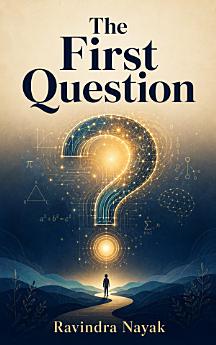
THE FIRST QUESTION: Nothing is assumed. Everything is built.
About this ebook
The First Question begins before the formulas, before the code, and before the jargon. It begins with a cup on a table and a deceptively simple challenge: can you describe what is there before your mind rushes to explain it? From that small act of attention, the book builds a complete first-principles learning journey for readers who want to understand complex ideas without pretending to understand what was never made clear.
Through natural dialogue, physical-world experiments, visual maps, short reflective poems, retrieval exercises, and practical thinking tools, you learn how to separate observation from interpretation, expose hidden assumptions, ask for evidence, compare fairly, design a tiny experiment, test a pattern against new cases, write an explicit rule, trace a mistake, and see how work moves through handoffs, queues, bottlenecks, dependencies, and exceptions. Mathematics enters only when a number genuinely improves the question. AI appears as a transfer context—something to question, test, compare, and verify rather than something to accept because it sounds confident.
This is not a book that asks non-technical readers to become technical overnight. It teaches the mental habits that make later mathematics, computers, data, AI, agents, and systems easier to approach. Each layer earns the next. Each chapter gives the reader a reason to care before introducing a new term. And when the book reaches more demanding ideas—variables, baselines, repeated trials, counterexamples, state, loops, debugging, capacity, and flow—they arrive through ordinary situations the reader can already picture.
The final Value Edition turns the entire book into a reusable learning system. You will retrieve ideas from memory instead of only rereading them, rebuild concepts in your own words, transfer them into new problems, use an error notebook productively, break intimidating complexity into smaller decisions, and work through a complete first-principles capstone. A plain-language glossary and reusable thinking cards make the book useful long after the first reading.
The First Question is for curious adults, lifelong learners, students returning to learning, professionals who feel left behind by technical language, and anyone who wants a calmer route into the age of AI. You do not need a mathematics background. You do not need coding experience. You only need the willingness to look carefully, ask one honest question, and let the answer change what you do next.
Because before we can count the world, model it, automate it, or ask a machine to reason about it, we need to know what we are actually looking at.
Discover more
About the author
Ravindra Nayak writes accessible, first-principles books for readers who want to understand complex ideas without being overwhelmed by technical language. His work brings together clear explanation, natural dialogue, practical exercises, visual thinking, reflective storytelling, and step-by-step learning. He focuses on helping non-technical readers build confidence before complexity, especially where mathematics, computers, AI, and everyday problem solving meet. The goal of his writing is not to make difficult subjects look impressive, but to make the foundations clear enough that readers can keep learning for themselves.