About this ebook
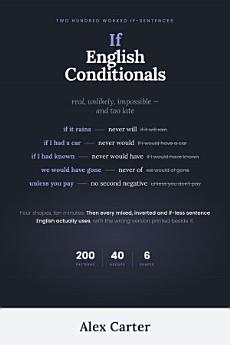
The book drops the classroom numbering. Nobody speaking English thinks I shall now use a second conditional; what they do is choose a tense one step further back than the real time, as a way of marking the sentence unreal. That single idea explains why a present-day hypothesis takes a past tense and a past-day one takes a past perfect, and every entry here says what the pattern claims about reality rather than what a textbook calls it.
Six parts: the four shapes, the two real ones that carry most of a working day, the unreal present that is the grammar of imagining and of politeness, the unreal past that is the grammar of hindsight, what happens when the two halves sit in different times, and the fifteen other words English uses to build a condition - unless, provided, in case, even if, as if.
Three errors carry almost all the damage: will after if, would after if, and would of for would have. They are drilled twice and listed on the reference page at the back with four others.
Discover more
About the author
Alex Carter writes practical English books for people who use the language at work and in ordinary life rather than in a classroom. The books are built around complete examples - real sentences, real situations - on the principle that one worked example teaches more than a page of rules.