About this ebook
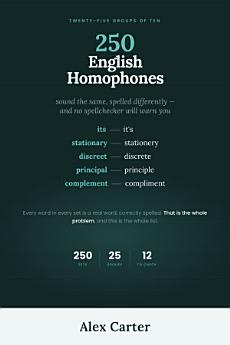
English has more homophones than almost any other language, for a reason that is nobody's fault: the spelling was fixed in print in the fifteenth and sixteenth centuries and the pronunciation carried on changing for four hundred years afterwards. The writing froze and the speech did not.
Two hundred and fifty sets, each with a short gloss for every member and one sentence using them all — The stationery van was stationary outside the gate. Sorted by the kind of word rather than alphabetically: the ten sets that account for most of the errors in written English, the short grammar words, everyday vocabulary, the near-homophones that are confused even more often than the real ones, the long words that appear in applications and reports where a slip costs most, and the sets that are homophones only in some accents.
Nothing in this book can be caught by a spellchecker, because every word in every set is a real word correctly spelled. That is the whole reason it exists. With a twelve-point list at the back of the ones to check before sending anything.
Discover more
About the author
Alex Carter writes practical English books for people who use the language at work and in ordinary life rather than in a classroom. The books are built around complete examples — real emails, real conversations, real sentences — on the principle that one worked example teaches more than a page of rules.