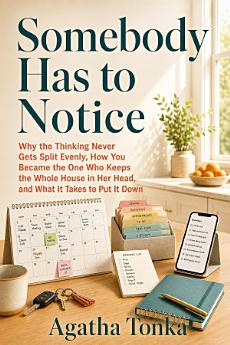
Somebody Has to Notice: Why the Thinking Never Gets Split Evenly, How You Became the One Who Keeps the Whole House in Her Head, and What It Takes to Put It Down
About this ebook
It is twenty to ten on a Tuesday. You are standing at the open refrigerator, not hungry, holding a permission slip you found under a banana peel at the bottom of a backpack, due Friday. The water filter light has been orange for two weeks, and nobody else in the house can see it. On the shared calendar the chores really are divided, color coded, and he does his half. You still know the shoes are getting tight and the middle one has gone quiet since Sunday. When a friend asks how you are and means it, nothing you say sounds big enough to explain the tiredness.
Somebody Has to Notice gives that work a name. Agatha Tonka borrows her vocabulary from the sociologist Allison Daminger, who described the thinking side of household labor in four parts: anticipating what is coming, spotting what is needed, making the decisions and checking that things got done. With that language the mental load becomes precise enough to argue about. The book shows how the job became yours in the first apartment, when your hands were faster with the burned out bulb, and why never mind, I will just do it teaches a partner not to see. It also explains why asking for help can make the whole thing worse.
Then you count. You keep a written tally of the noticing, and you start to understand why you could not rest on the balcony of a vacation you booked in February. The last part hands the work back one whole domain at a time, with one sentence said once and no case built behind it. It asks you to let one thing fail. It prepares you for the Thursday he calls up the stairs to ask when the dentist is again, and it leaves you room to choose what you want to keep holding.
This is a book about invisible labor and cognitive load at home, written for the woman who already tried the chore chart. The author names Fair Play and How to Keep House While Drowning as good books for dividing tasks and easing shame about mess, and says plainly that this one covers the thinking neither of them reaches. There is no villain here. Two decent people ended up in an arrangement neither of them chose.
This book is general information and reflection, and it is not therapy or relationship counseling.
Discover more
About the author
Agatha Tonka writes about the work women do that nobody counts. Her books deal with the arrangements that form quietly, without anyone deciding them: who ends up taking the notes, who gets volunteered, who becomes the person everybody rings first, and what it costs to be reliable. She is interested in the mechanism rather than the villain, which is why her books tend not to have one. She writes for the woman who has read the advice, tried it, and found it did not fit her situation, usually because the advice assumed somebody was behaving badly and in her house nobody is.