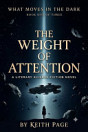
What We Carried to the Dark
About this ebook
In seventy years, a gamma-ray burst will sterilize Earth. The math is certain. The survival of eight billion people is not.
Six people are sent to stop it.
Kenji, the captain who has spent his life building the framework that might save everyone, and who carries a folded piece of paper in his breast pocket that he will not put down.
Miguel, who cooks like he is feeding the whole world and whose hands never shake, even when they should.
Wei, the commander who keeps everyone alive by keeping everything five degrees outside the circle.
Dmitri, who built the engine they are flying in, alone in a warehouse, because he believed in it before anyone else did.
Jack, a high school physics teacher from Cleveland who made a forum post at two in the morning and somehow ended up here.
Giang, a pharmacist who watches everything and says little and understands, always, exactly what is happening.
And then there is Zeebo.
Zeebo is MIRU — four arms, eighty pounds, a purr that fills whatever room he is in, and a gift for inserting himself into every situation at every hour with the complete confidence of a creature who knows he belongs exactly where he is. He should not be the emotional center of an epic about the survival of all sentient life in four star systems.
He is anyway.
What We Carried to the Dark is a literary science fiction novel about what it costs to go when someone has to go — and what gets carried across the distance that no mission briefing ever thinks to mention.
Literary science fiction.
Discover more
About the author
Keith Page is a writer who explores the quiet power of human focus in a chaotic universe. His debut novel, What We Carried to the Dark, examines the intersection of deep-space logistics and the human capacity for connection. When not writing about tactical vessels or asteroid-dwelling pilots, Keith is an advocate for the art of paying attention to the right things. He lives in Santa Fe, New Mexico