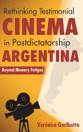
Rethinking Testimonial Cinema in Postdictatorship Argentina: Beyond Memory Fatigue

· Indiana University Press
Ebook
216
Pages
Tools
Eligible

About this ebook

For roughly two decades after the collapse of the military regime in 1983, testimonial narrative was viewed and received as a privileged genre in Argentina. Today, however, academics and public intellectuals are experiencing "memory fatigue," a backlash against the concepts of memory and trauma, just as memory and testimonial films have reached the center of Argentinian public discourse. In Rethinking Testimonial Cinema in Postdictatorship Argentina, Verónica Garibotto looks at the causes for this reticence and argues that, rather than discarding memory texts for their repetitive excess, it is necessary to acknowledge them and their exhaustion as discourses of the present.

By critically examining how trauma theory and subaltern studies have previously been applied to testimonial cinema, Garibotto rereads Argentinian films produced since 1983 and calls for an alternate interpretive framework at the intersection of semiotics, theories of affect, scholarship on hegemony, and the ideological uses of documentary and fiction. She argues that recurrent concepts—such as trauma, mourning, memory, and subalternity—miss how testimonial films have changed over time, shifting from subaltern narratives to official, hegemonic, and iconic accounts. Her work highlights the urgent need to continue to study these types of narratives, particularly at a time when military dictatorships have become entrenched in Latin America and memory narratives proliferate worldwide. Although Argentina is Garibotto's focus, her theory can be adapted to other contexts in which narratives about recent political conflicts have shifted from alternative versions of history to official, hegemonic accounts—such as in Spanish, Chilean, Uruguayan, Brazilian, South African, and Holocaust testimonies. Garibotto's study of testimonial cinema moves us to pursue a broader ideological analysis of the links between film and historical representation.

For roughly two decades after the collapse of the military regime in 1983, testimonial narrative was viewed and received as a privileged genre in Argentina. Today, however, academics and public intellectuals are experiencing "memory fatigue," a backlash against the concepts of memory and trauma, ...

Discover more

About the author

Verónica Garibotto is Associate Professor of Latin American Literary and Cultural Studies at the University of Kansas. She is the author of Crisis y reemergencia: el siglo XIX en la ficción contemporánea de Argentina, Chile y Uruguay and editor (with Jorge Pérez) of The Latin American Road Movie.
Verónica Garibotto is Associate Professor of Latin American Literary and Cultural Studies at the University of Kansas. She is the author of Crisis y reemergencia: el siglo XIX en la ficción contemporánea de Argentina, Chile y Uruguay and editor (with Jorge Pérez) of The Latin American Road Movie.

Rate this ebook

Tell us what you think.

Reading information

Smartphones and tablets
Install the Google Play Books app for Android and iPad/iPhone. It syncs automatically with your account and allows you to read online or offline wherever you are.
Laptops and computers
You can listen to audiobooks purchased on Google Play using your computer's web browser.
eReaders and other devices
To read on e-ink devices like Kobo eReaders, you'll need to download a file and transfer it to your device. Follow the detailed Help Center instructions to transfer the files to supported eReaders.