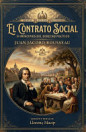
Social Contract, The - Jean-Jacques Rousseau: An Eighteenth-Century Treatise on Political Philosophy
About this ebook
In The Social Contract, Jean-Jacques Rousseau explores the essential question of political legitimacy: How can individuals remain free while living under a governing body? Written in 1762, this foundational work of the Enlightenment argues that true authority rests not with monarchs, but with the "General Will" of the people.
Through a rigorous analysis of civil society, Rousseau introduces concepts that would later ignite the flames of the French and American Revolutions:
The Origin of Inequality: How the transition from nature to society shapes human freedom.
The Sovereign Will: Why the power to make laws must belong solely to the citizens.
The Balance of Power: The delicate relationship between the executive government and the legislative body.
This edition offers a clear and faithful presentation of Rousseau’s arguments, making it an essential addition to the library of students, philosophers, and anyone interested in the roots of modern democracy.
Discover more
About the author
Jean-Jacques Rousseau (1712–1778) was a Genevan philosopher, writer, and composer whose political philosophy profoundly influenced the progress of the Enlightenment throughout Europe, as well as aspects of the French Revolution and the development of modern political, economic, and educational thought.
Born in Geneva, Rousseau led a peripatetic life, eventually moving to Paris where he became an influential figure among the philosophes. Unlike many of his contemporaries, Rousseau was often at odds with the mainstream Enlightenment, particularly regarding his views on the inherent goodness of man in a state of nature versus the corrupting influence of society.
His most celebrated works, including The Social Contract, Emile, or On Education, and his autobiographical Confessions, broke new ground in exploring the relationship between the individual and the collective. His concept of the "General Will" remains a cornerstone of democratic theory, while his emphasis on subjectivity and introspection in his memoirs is credited with laying the foundations for the Romantic movement in literature.
Today, Rousseau is recognized as one of the most provocative and enduring thinkers in Western history, whose ideas continue to spark debate on the nature of freedom, authority, and human rights.
G.D.H. Cole (1889–1959) was a distinguished English political theorist, economist, and historian who became one of the most influential figures in the British socialist movement during the first half of the 20th century. A prolific author and committed educator, he is best remembered as the primary architect of Guild Socialism, a theory that advocated for workers' control of industry through a system of national guilds.
Educated at Oxford, Cole spent much of his academic career as a Fellow of All Souls College and later as the Chichele Professor of Social and Political Theory. His intellectual output was vast, spanning from rigorous economic analyses and histories of the labor movement to his monumental multi-volume work, A History of Socialist Thought. Beyond his academic contributions, Cole was a prominent member of the Fabian Society and a frequent contributor to the New Statesman.
Interestingly, Cole also maintained a successful second career as a writer of detective fiction, co-authoring dozens of popular mystery novels with his wife, Margaret Cole. His unique ability to bridge the gap between complex political theory and accessible prose makes his work essential for understanding the evolution of democratic and socialist ideals in the modern era.
Llorenç Macip is a prolific author, independent publisher, and translator dedicated to the preservation and revitalization of classical literature through regional dialects and minor languages. With a professional focus on comparative linguistics and digital publishing standards, Macip bridges the gap between historical masterpieces and modern accessibility.
As the driving force behind an ambitious editorial project, he maintains a rigorous publication schedule, specializing in the translation of foundational texts—such as Lazarillo de Tormes—into unique linguistic varieties including Doric, Ladino, and Mirandés. His work is characterized by technical precision, adhering to high-quality EPUB standards and phonetic accuracy in every edition.
Beyond his linguistic research, Macip is the author of technical manuals focused on practical self-sufficiency and sustainable living. His dual expertise in the humanities and practical sovereignty reflects a holistic approach to knowledge, making his catalog an essential resource for scholars of dialectology and enthusiasts of independent, high-quality digital literature.