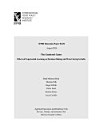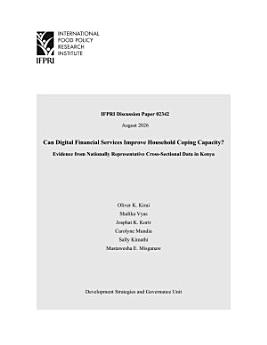
Can digital financial services improve household coping capacity? Evidence from nationally representative cross-sectional data in Kenya
Kirui, Oliver K. · Vyas, Shalika · Korir, Josphat K. · Mundia, Carolyne · Kimathi, Sally · Misganaw, Mastawesha E.
Aug 2026 · IFPRI Discussion Paper Book 2432 · International Food Policy Research Institute
Ebook
54
Pages
family_home
Eligible
info
About this ebook
Digital financial services (DFS) have expanded financial access in Kenya, but their contribution to household coping capacity may differ substantially across product types. This paper examines trends and socioeconomic correlates of DFS adoption and the associations between DFS use and household coping capacity using nationally representative FinAccess surveys from 2019, 2021, and 2024. The analysis combines descriptive statistics and pooled logistic regressions with inverse-probability-weighted-regression adjustment and propensity score matching. We distinguish between mobile banking savings, mobile money savings, mobile banking loans, mobile provider loans, and app-based digital credit. Mobile phone ownership, internet access, education, income, and financial decision-making are important correlates of adoption, though significant gender and regional disparities remain. Digital savings show the broadest and most consistent positive associations with household coping capacity. Mobile banking savings are associated with an increase of 14 percentage points in emergency saving, an increase of 7.5 percentage points in access to emergency funds, and reductions of 4 and 2.7 percentage points in food insecurity and difficulty accessing medical care, respectively. Mobile banking loans provide narrower benefits, mainly for financial planning and emergency liquidity. In contrast, app-based loans are associated with reduced emergency savings and financial endurance. The findings show that the welfare implications of DFS depend critically on product type. Savings-led digital finance can strengthen household preparedness, while short-term app-based credit may increase financial vulnerability.
Digital financial services (DFS) have expanded financial access in Kenya, but their contribution to household coping capacity may differ substantially across product types. This paper examines trends and socioeconomic correlates of DFS adoption and the associations between DFS use and household c...
Discover more
Rate this ebook
Tell us what you think.
Reading information
Smartphones and tablets
Install the Google Play Books app for Android and iPad/iPhone. It syncs automatically with your account and allows you to read online or offline wherever you are.
Laptops and computers
You can listen to audiobooks purchased on Google Play using your computer's web browser.
eReaders and other devices
To read on e-ink devices like Kobo eReaders, you'll need to download a file and transfer it to your device. Follow the detailed Help Center instructions to transfer the files to supported eReaders.