About this ebook
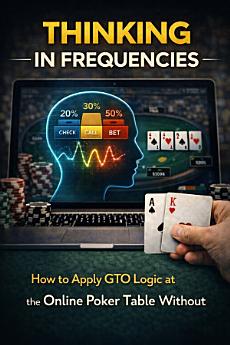
Thinking in frequencies means approaching every poker decision not as an isolated choice but as part of a strategy across your entire range of hands. When you face a certain spot — say, a continuation bet opportunity on a specific board texture — you're not just deciding what to do with the particular hand you hold right now. You're deciding what your strategy is for all the hands you can hold in that situation. How often will you bet? How often will you check? And how do you distribute your bets and checks across your strong hands, your medium hands, and your bluffs?
This sounds abstract, but thinking in frequencies quickly becomes intuitive with practice. And the payoff is significant: a frequency-based approach keeps your strategy balanced, makes you difficult to exploit, and provides a reliable framework for decision-making even in spots you haven't specifically studied. Instead of asking "what should I do with this hand?" you ask "what frequency should I be betting in this type of spot, and does this hand belong in the betting range or the checking range?" This small shift in question produces dramatically better decisions.
This book bridges the gap between solver theory and practical application. You'll learn the key frequencies that matter most at the tables on Bovada and Ignition — how often to continuation bet on various board textures, how to construct balanced river betting ranges with the right ratio of value to bluffs, how often to defend against bets to avoid being exploited, and how often to 3-bet in different positions. These aren't numbers you need to memorize — they're ranges of understanding that let you make confident, principled decisions.
Thinking in frequencies also develops a more sophisticated form of hand reading. When you understand how an opponent should be distributed across their range in a given spot, deviations from expected frequencies become informative tells. An opponent who bets every river is bluffing too much. One who never bets without a strong hand is value betting too infrequently. Thinking in frequencies lets you identify and exploit these patterns.
On the anonymous tables of Bovada and Ignition, where data-driven reads aren't available, frequency-based thinking is your most reliable navigation tool. This book teaches you to use it.
Discover more
About the author
The author is the editor of casinoonlinegaming.com greenbaycasino.com and slotbonuses.info, where they publish educational articles analyzing casino games from a mathematical and probabilistic perspective. That work focuses on game structure, probability, and common misconceptions rather than betting advice, systems, or strategies.
Writing under the Games Explained Honestly imprint, the author specializes in clear, probability-first explanations of casino games and gambling mechanics. Rather than offering methods to win or promises of outcomes, the work examines how games are designed, how probabilities are fixed, and why player experience often conflicts with mathematical reality.
The books in this series draw on publicly available information, standard principles of probability, and established concepts from game design and behavioral psychology. They are written for readers who want understanding instead of folklore, clarity instead of illusion, and explanations grounded in structure rather than belief.
The author does not provide legal advice, gambling advice, financial advice, or recommendations. All content is educational in nature and intended to help readers better interpret chance-based games and their own experiences with them.