About this ebook
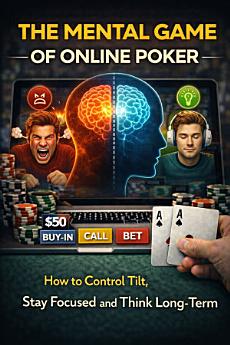
Tilt is the most immediate and most costly form of mental game failure. It happens when an emotional response to a bad outcome — a bad beat, a cooler, a session of running below expectation — causes you to deviate from your best strategic thinking. You start making decisions based on frustration, desire to get even, or a distorted sense of the game rather than logic and probability. The mental game of poker teaches you to recognize tilt in its early stages, interrupt it before it escalates, and return to your best thinking quickly.
But the mental game of poker extends well beyond tilt control. This book covers the full landscape of psychological challenges that online poker presents. Variance is one of the most psychologically difficult aspects of the game — periods where you play well and lose anyway, where the results don't reflect your decisions, where it's genuinely hard to know whether you're running bad or playing poorly. Developing the emotional resilience to stay grounded during these periods, and the analytical clarity to evaluate your play objectively, is a core skill this book develops.
Focus is another major component of the mental game of poker in online settings. Playing on Bovada or Ignition from home means dealing with distractions that don't exist in a live casino: phones, notifications, background noise, the temptation to multitable beyond your effective capacity. This book addresses the practical habits and environmental controls that keep your focus sharp during sessions, as well as the cognitive strategies that help you maintain concentration over extended play.
Long-term thinking — genuinely internalizing that poker is a game of thousands of hands rather than individual sessions — is perhaps the deepest skill the mental game of poker requires. Results in any given session are largely noise. The signal only emerges over large sample sizes. Players who understand this at an emotional level, not just an intellectual one, make better decisions in the moment because they're not overweighting short-term outcomes.
The mental game of poker is what separates players who know what to do from players who actually do it consistently. This book is the training manual for developing that consistency.
Discover more
About the author
The author is the editor of casinoonlinegaming.com greenbaycasino.com and slotbonuses.info, where they publish educational articles analyzing casino games from a mathematical and probabilistic perspective. That work focuses on game structure, probability, and common misconceptions rather than betting advice, systems, or strategies.
Writing under the Games Explained Honestly imprint, the author specializes in clear, probability-first explanations of casino games and gambling mechanics. Rather than offering methods to win or promises of outcomes, the work examines how games are designed, how probabilities are fixed, and why player experience often conflicts with mathematical reality.
The books in this series draw on publicly available information, standard principles of probability, and established concepts from game design and behavioral psychology. They are written for readers who want understanding instead of folklore, clarity instead of illusion, and explanations grounded in structure rather than belief.
The author does not provide legal advice, gambling advice, financial advice, or recommendations. All content is educational in nature and intended to help readers better interpret chance-based games and their own experiences with them.