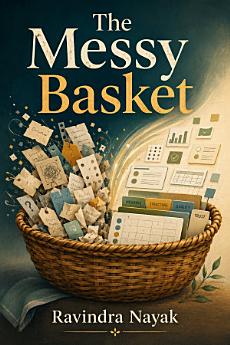
THE MESSY BASKET
About this ebook
The Messy Basket is a calm, visual, first-principles guide to that hidden work.
Written for readers who do not come from a technical background, the book begins with ordinary objects, paper slips, conversations, simple counts, and practical questions. Instead of asking you to memorize data-science vocabulary, it lets you feel the problem first. What makes two rows duplicates? When is a missing value an error—and when is the blank itself information? Can a tidy sample still misrepresent the world? Why can a useful feature become a misleading proxy? How can information leak from the future into a dataset? What changes when we group, encode, impute, aggregate, or join records?
Through Mira and Kabir’s conversations, hands-on thought experiments, mind maps, small mathematical examples, and practical field tools, the book gradually builds a working understanding of data cleaning, data quality, missing values, sampling bias, class balance, rare cases, subgroup coverage, feature selection, proxy variables, data leakage, labels, transformations, verification, drift, and responsible data handoff.
The mathematics is deliberately gentle. Mean and median, percentages, frequency balance, range, ratios, and simple rescaling appear only when they help the reader see something that words alone cannot show. The goal is not to turn the reader into a statistician. It is to make the reasoning underneath modern data and machine-learning systems understandable.
As the book progresses, preparation becomes more than “cleaning.” You learn to ask whether a dataset is fit for its purpose, whether its sample represents the intended world, whether labels carry uncertainty, whether transformations preserve meaning, whether historical preparation matches real-world use, and whether another person could safely understand the data after it changes hands.
The final Value Edition turns the ideas into practice. It includes retrieval exercises, fear-free mathematics, problem chunking, error diagnosis, counterexample training, teach-back drills, a full case lab, a 14-day Mind Lab, a glossary, and a practical Reader’s Field Kit.
The Messy Basket is for curious professionals, students, managers, creators, career changers, and everyday learners who want to understand the foundations of data and machine learning without being buried in code or jargon.
Because better learning does not begin with a smarter model.
It begins with better questions about the data.
Discover more
About the author
Ravindra Nayak writes accessible, first-principles books for readers who want to understand complex ideas without being overwhelmed by technical language. His work brings together clear explanation, natural dialogue, practical exercises, visual thinking, and reflective storytelling so that knowledge can become useful in everyday life. Through The First-Principles Mind Lab, he focuses on helping non-technical readers build confidence with mathematics, data, computing, and AI by starting with familiar experiences and layering understanding gradually.