About this ebook
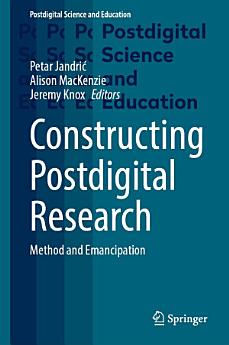
Constructing Postdigital Research: Method and Emancipation is complemented by Postdigital Research: Genealogies, Challenges, and Future Perspectives, also edited by Petar Jandrić, Alison MacKenzie, and Jeremy Knox, which explores these questions in theory.
Discover more
About the author
Petar Jandrić is Professor at the Zagreb University of Applied Sciences, Croatia. Petar’s research interests are at the postdisciplinary intersections between technologies, pedagogies, and the society, and research methodologies of his choice are inter-, trans-, and antidisciplinarity. He is the Editor-in-Chief of Postdigital Science and Education journal, https://www.springer.com/journal/42438, Postdigital Science and Education book series, https://www.springer.com/series/16439, and Encyclopedia of Postdigital Science and Education, https://link.springer.com/referencework/10.1007/978-3-031-35469-4. His recent books include The Methodology and Philosophy of Collective Writing (2021), Bioinformational Philosophy and Postdigital Knowledge Ecologies (2022), Postdigital Ecopedagogies: Genealogies, Contradictions, and Possible Futures (2022), and Postdigital Research: Genealogies, Challenges, and Future Perspectives (2023). Personal website: http://petarjandric.com/.
Alison MacKenzie is a Reader at Queen’s University, Belfast. Alison’s research interests are in applied philosophy, particularly feminist and postdigital philosophy, epistemic injustice, and the related fields of epistemologies of ignorance and deceit. Alison has written on critical disability, the Capabilities Approach, and Bourdieusian analytical sociology. Alison is an Associate Editor of the International Journal of Educational Research and is on the editorial board of a number of journals, including Postdigital Science and Education. Her recent edited books are Epistemology of Deceit in a Postdigital Era (2021) and Postdigital Research: Genealogies, Challenges, and Future Perspectives (2023).
Jeremy Knox is Senior Lecturer and Co-director of the Centre for Research in Digital Education at the University of Edinburgh. His research interests include the relationships between education, data-driven technologies, and wider society, and he has led projects funded by the ESRC and the British Council in the UK. Jeremy’s published work includes Posthumanism and the MOOC (2016), Artificial Intelligence and Inclusive Education (2019), The Manifesto for Teaching Online (2020), Data Justice and the Right to the City (2022), AI and Education in China (2023), and Postdigital Research: Genealogies, Challenges, and Future Perspectives (2023).