About this ebook
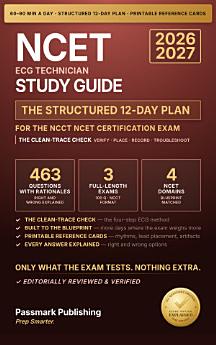
You have an NCET date. Hold it. Between now and then: 463 questions with every option explained. Three timed practice exams at the exam's 100-item scored length. A 12-day plan that opens with a diagnostic. No login, no expiry.
We built this the way a cardiology instructor runs a monitor-tech course, not the way a shelf gets filled. Our source is NCCT's Detailed Test Plan, effective January 2024: 180 minutes, 125 items, 100 of them scored. Weights run 36 ECG Recording and Recognition, 25 ECG Placement Techniques, 24 Patient Intake and Compliance, 15 Troubleshooting. Rhythm reading is the largest single share, and it is still barely a third of the paper. Twelve days means a diagnostic plus eleven teaching days, split the way NCCT splits the score. Check us against NCCT's published test plan, domain by domain. We would rather you did.
What's inside
A 25-question diagnostic before any teaching. Half an hour, and you know which of the four domains is quietly costing you points.
The Clean-Trace Check. Verify, place, record, troubleshoot: four steps from two patient identifiers to a strip a provider can act on. When the exam asks what happens next, the check answers it.
463 original questions, written for this book to the current NCCT plan. Each one explains the right answer and the specific mistake behind every wrong option.
Three practice exams, timed, at 100 questions, the exam's scored length. Two cumulative reviews sit ahead of them, so week one is still with you in week two.
Rhythm criteria you apply in a fixed order. Rate, regularity, P waves, PR interval, QRS width, on every strip, until an unfamiliar rhythm stops being unfamiliar.
Printable reference cards. Twelve-lead placement with limb-lead colors, rhythm criteria, artifact fixes, and one page for scope, vitals and infection control. Maybe the last EKG book you bought turned out to be a rhythm atlas with a quiz at the back. Give this one three evenings. If the diagnostic tells you nothing you did not already suspect, put it down. An hour is all it cost.
Three readers get real use from it. Someone finishing an NCCT-eligible ECG or cardiac monitoring program. A medical assistant or patient care tech adding the credential. A monitor tech certifying on hours already worked. If lead placement is already your day job, start at Day 7.
Day 9 is the hard one: ventricular, junctional and block rhythms in a single sitting. You'll find the strips stop looking alike afterwards. Downloaded once, yours to keep.
— The Passmark Publishing Team
An independent study guide from Passmark Publishing. Not affiliated with or endorsed by the National Center for Competency Testing. NCCT and NCET are trademarks of the National Center for Competency Testing. For exam preparation only; not medical advice.
You have an NCET date. Hold it. Between now and then: 463 questions with every option explained. Three timed practice exams at the exam's 100-item scored length. A 12-day plan that opens with a diagnostic. No login, no expiry.
We built this the way a cardiology instructor runs a monitor-tech co...
Discover more
About the author
Passmark builds one kind of book: the one that makes your study hours count. We start from a simple conviction — a certification exam is a skills test, not a memory test — so we never hand you a wall of facts to reread. Our method comes from the science of how memory actually holds: you learn by retrieving, not rereading; you revisit on a widening schedule so it sticks; every answer is explained, right and wrong, so you keep the reasoning; and a diagnostic points your hours where they will move your score. We read each exam's current blueprint ourselves, write every question from scratch, and check every number in the book — question counts, domain weights, practice tests — against the finished pages, not the marketing. When an exam changes, our books change with it.
Passmark builds one kind of book: the one that makes your study hours count. We start from a simple conviction — a certification exam is a skills test, not a memory test — so we never hand you a wall of facts to reread. Our method comes from the science of how memory actually holds: you learn by ...
Rate this ebook
Tell us what you think.
Reading information
Smartphones and tablets
Install the Google Play Books app for Android and iPad/iPhone. It syncs automatically with your account and allows you to read online or offline wherever you are.
Laptops and computers
You can listen to audiobooks purchased on Google Play using your computer's web browser.
eReaders and other devices
To read on e-ink devices like Kobo eReaders, you'll need to download a file and transfer it to your device. Follow the detailed Help Center instructions to transfer the files to supported eReaders.