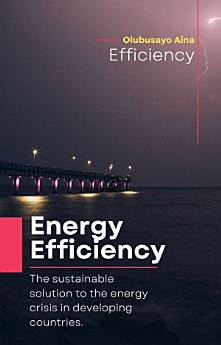
Energy Efficiency: The sustainable solution to the energy crisis in developing countries
About this ebook
As usual, they don’t see what goes on, until it’s passed!
Achieving the ‘zero-carbon’ status might be a long stretch for those in pursuit – particularly as embedded carbon is still an enigma; what can however, not be denied, are the positive impacts this venture will have on their environments, and energy economies.
Attaining carbon neutrality, not only needs political will; But it also requires financial capabilities too.
Elements, that are far and few in the third World countries.
But I say, if we don’t have the muscle, we can leverage on the brains!
On face value, we could easily point corruption, and the lack of political will, as the major reasons for the energy crisis in developing countries; A closer review will however, expose a greater depth to the wroth.
And whilst we can trade blames forever, on the negligence of governments and governmental institutions in finding smart solutions to energy problems in these regions; the facts do clearly show, that ‘approach’ is more of a problem, than ‘intent’.
I have a theory that sees energy efficiency as a compulsory prerequisite to renewable energy deployments, before optimal value can be gotten from grid installations, in third World countries.
This is a proven technique for energy savings, carbon reduction and energy sustainability.
And the UK retrofit initiative, is a testament to this.
Currently, in developing Countries, emphasis is mostly placed on grid deployments.
Having massive energy potential from the sunlight, doesn’t necessarily translate into successes in Solar Photovoltaic grid installations;
And the third World countries are fast realizing this.
I highlighted earlier, that we don’t have the financial muscle of the western World.
But what we’re not in short of, is skills adaptation.
The retrofit agenda in the United Kingdom - though produces the desired energy results; could at times, be very capital intensive.
And capital, is what we don’t have in developing countries!
Even when the capital is available, some other unsavory uses are found for them.
This then highlights the need for tailored energy efficiency approaches, that would be applicable for third World countries.
For starters; in developing countries, social amenities are often provided by the citizens themselves - with governments lacking in their basic responsibilities.
Hence, it is unfeasible to expect home owners to single-handedly retrofit their homes, knowing fully well that the costs applicable, would be enormous.
In this book, I outlined simple ways through which technicians, energy consultants, individual home owners and businesses in developing countries, can apply energy efficiency initiatives, before renewable energy installations are deployed.
This, will not only guarantee energy savings and the smarter use of energy; but will also start us, on our own national quests to carbon neutrality.