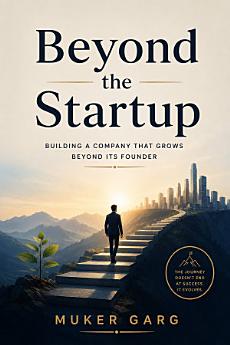
Beyond the Startup
Muker Garg
Archana Kulshrestha
Ebook
118
Pages
Tools
info
About this ebook
# Beyond the Startup Starting a business is exciting, but building a startup is only the beginning. The real challenge begins when the initial idea has been tested, the first customers arrive, and the company must prove that it can survive, grow, and create lasting value. **Beyond the Startup** explores what happens after the early stage of entrepreneurship—the stage where founders must move beyond ideas, enthusiasm, and experimentation and begin building a real, scalable business. Many startups begin with a powerful vision. Founders work long hours, solve problems, attract early customers, build products, raise capital, and compete for attention. But early success does not automatically create a sustainable company. A startup can have a great product and still fail because of weak systems, poor financial management, ineffective leadership, unclear positioning, or uncontrolled growth. This book focuses on the transition from startup thinking to long-term business thinking. It is for founders, entrepreneurs, business owners, aspiring leaders, and anyone who wants to understand how companies move from uncertainty to stability and from stability to meaningful growth. It explores the decisions that become increasingly important as a company becomes larger and more complex. One of the biggest challenges after the startup phase is learning how to scale without losing control. What worked when a company had five employees may not work when it has fifty or five hundred. Informal communication may need to become structured. Founder-driven decision-making may need to become distributed leadership. Manual processes may need to become systems. The founder's personal effort can no longer be the engine behind everything. The business must learn to operate as an organization rather than simply as a project powered by its founder. **Beyond the Startup** examines how entrepreneurs can build systems that support sustainable growth. It explores operations, hiring, leadership, company culture, customer relationships, financial discipline, technology, marketing, sales, and strategic decision-making. Growth itself is not always success. Growing too quickly can create cash-flow problems, operational chaos, customer-service failures, hiring mistakes, and management challenges. The goal is not simply to make a company bigger. The goal is to make it stronger. This book encourages entrepreneurs to think carefully about the difference between revenue growth and business quality. A company can increase sales while becoming less profitable. It can acquire customers while losing them just as quickly. It can hire more employees while becoming less productive. Sustainable growth requires balance. Another important theme is the founder's role. In the early days, founders often become involved in everything. They sell, design, recruit, negotiate, solve customer problems, manage finances, and make nearly every important decision. This involvement may be necessary initially, but eventually it can become a limitation. A company cannot truly scale if every decision must pass through one person. Founders must learn to delegate, develop leaders, establish accountability, and create a culture where capable people can make decisions independently. This transition can be difficult because delegation requires trust. It also requires founders to accept that other people may solve problems differently from the way they would. The book explores how to make that transition without losing the company's original vision. **Beyond the Startup** also examines the importance of customers. Early customers may be attracted by novelty, personal relationships, or the founder's passion. Long-term businesses need something stronger: consistent value. Understanding why customers stay, why they leave, what they truly value, and how their needs change can become one of the company's most important competitive advantages. The book also looks closely at financial discipline. Revenue can create excitement, but revenue alone does not guarantee a healthy business. Entrepreneurs need to understand costs, margins, cash flow, profitability, capital allocation, and financial risk. A growing company needs enough financial strength to survive difficult periods and enough discipline to avoid spending simply because money is available. Beyond financial numbers, entrepreneurs must also learn how to think strategically. Competition changes. Markets evolve. Customer expectations shift. Technology can transform entire industries. A strategy that worked two years ago may become ineffective tomorrow. Successful companies develop the ability to adapt without constantly changing direction. This requires clarity about what the business is trying to become. The book explores how to identify competitive advantages, build strong positioning, create differentiated value, and make decisions based on long-term objectives rather than short-term pressure. Leadership becomes increasingly important as the company grows. A founder who motivates a small team through personal energy may need a different leadership approach when managing a larger organization. Employees need clarity, trust, feedback, opportunities, accountability, and a meaningful reason to contribute. Company culture cannot simply be a slogan. It must appear in everyday decisions and behavior. **Beyond the Startup** therefore treats leadership as a business system, not just a personal quality. The book also addresses failure and uncertainty. No company grows perfectly. There will be missed targets, difficult employees, failed products, unexpected competitors, economic challenges, and strategic mistakes. Strong businesses are not those that never experience problems. They are businesses capable of learning, adapting, and recovering. Entrepreneurship after the startup phase requires resilience of a different kind. It requires patience. It requires the ability to stop chasing every opportunity and focus on the opportunities that genuinely strengthen the company. It requires knowing when to accelerate, when to slow down, when to experiment, and when to say no. Ultimately, **Beyond the Startup** is about building a company that can outgrow its earliest version of itself. The goal is not merely to survive the startup stage. It is to create an organization capable of operating, adapting, competing, and creating value for years to come. Starting a company requires courage. Growing one requires discipline. Scaling one requires systems. Leading one for the long term requires vision. **Beyond the Startup** is a guide to that next chapter—the chapter where entrepreneurship becomes leadership, growth becomes a system, and a promising startup begins transforming into a durable business.
# Beyond the Startup Starting a business is exciting, but building a startup is only the beginning. The real challenge begins when the initial idea has been tested, the first customers arrive, and the company must prove that it can survive, grow, and create lasting value. **Beyond the Startup** e...
Discover more
About the author
Muker Garg is a creative professional and author. Through his writing, he shares practical insights on business growth, strategy, creativity, and personal development, helping readers turn ideas into meaningful action and long-term success.
Muker Garg is a creative professional and author. Through his writing, he shares practical insights on business growth, strategy, creativity, and personal development, helping readers turn ideas into meaningful action and long-term success.
Rate this ebook
Tell us what you think.
Reading information
Smartphones and tablets
Install the Google Play Books app for Android and iPad/iPhone. It syncs automatically with your account and allows you to read online or offline wherever you are.
Laptops and computers
You can listen to audiobooks purchased on Google Play using your computer's web browser.
eReaders and other devices
To read on e-ink devices like Kobo eReaders, you'll need to download a file and transfer it to your device. Follow the detailed Help Center instructions to transfer the files to supported eReaders.