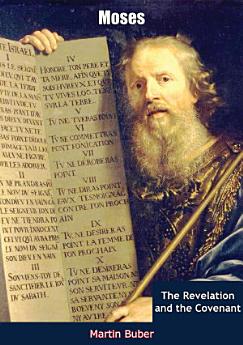
Moses: The Revelation and the Covenant
About this ebook
Buber—steeped as he is in the literature of the Old Testament—here seeks to disengage history from saga and to convey the meaning of Sinai to the 20th century.
"In this book a fascinating attempt is made to depict the historical Moses. The work is rich in brilliant comment. He has profound things to say on the flight of Moses to Midian, where he met with a life resembling that of his ancestors; on the Burning Bush, where he saw fire, but no form; and Moses before Pharaoh, as the first historical instance of prophet versus king; on the contrast between Moses summoned by God, and Balaam, made use of by Him. The style is invariably clear, precise and dignified. This is a book to be read, re-read and treasured."—David Daube, Regius Professor, Oxford University
Discover more
About the author
Martin Buber (1878-1965) was an Austrian philosopher best known for his philosophy of dialogue, a form of existentialism centered on the distinction between the I-Thou relationship and the I-It relationship.
Born on February 8, 1878 in Vienna, Austria, Buber came from a family of observant Jews, but broke with Jewish custom to pursue secular studies in philosophy. In 1898, he joined the Zionist movement, participating in congresses and organizational work. In 1902, he became the editor of the weekly Die Welt, the central organ of the Zionist movement. In 1923, Buber wrote his famous essay on existence, Ich und Du (later translated into English as I and Thou), and in 1925, he began translating the Hebrew Bible into the German language.
In 1930, Buber became an honorary professor at the University of Frankfurt am Main, but resigned from his professorship in protest immediately after Adolf Hitler came to power in 1933. He then founded the Central Office for Jewish Adult Education, which became an increasingly important body as the German government forbade Jews from public education. In 1938, Buber left Germany and settled in Jerusalem, Mandate Palestine, receiving a professorship at Hebrew University and lecturing in anthropology and introductory sociology.
Buber was nominated for the Nobel Prize in Literature ten times, and Nobel Peace Prize seven times.
He died at his home in the Talbiya neighborhood of Jerusalem on June 13, 1965, aged 87.