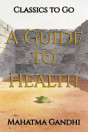
A Guide to Health
Mahatma Gandhi
Jan 1921 · Createspace Independent Publishing Platform
Ebook
147
Pages
About this ebook
In these days when the name of Mahatma Gandhi is identified with the momentous question of Non-Co-operation, it may come with a shock of surprise to most readers to be told that he is something of an authority on matters of Health and Disease as well. Very few of us perhaps are aware that he is the author of quite an original little Health-book in Gujarati. Those who think of him as a dreamy idealist or an unpractical visionary, with his head always in the clouds, will certainly be undeceived when they read this book replete from cover to cover with practical observations on the most practical question of Health. His views are of course radically different from the ordinary views that find expression in the pages of such books; in many cases, indeed, his doctrines must be pronounced revolutionary, and will doubtless be regarded by a certain class of readers as wholly impracticable.
In these days when the name of Mahatma Gandhi is identified with the momentous question of Non-Co-operation, it may come with a shock of surprise to most readers to be told that he is something of an authority on matters of Health and Disease as well. Very few of us perhaps are aware that he is t...
About the author
Mohandas Gandhi is well known as a political activist and pacifist who played a key role in achieving India's independence from Great Britain. Although born in Porbandar, India, to parents of the Vaisya (merchant) caste, he was given a modern education and eventually studied law in London. After returning briefly to India, Gandhi went to South Africa in 1893, where he spent the next 20 years working to secure Indian rights. It was during this time that he experimented with and developed his basic philosophy of life. Philosophically, Gandhi is best known for his ideas of satyagraha (truth-force) and ahimsa (nonharming). Intrinsic to the idea of truth-force is the correlation between truth and being; truth is not merely a mental correspondence with reality but a mode of existence. Hence, the power of the truth is not what one argues for but what one is. He developed this idea in conjunction with the principle of nonviolence, showing in his nationalist activities that the force of truth, expressed nonviolently, can be an irresistible political weapon against intolerance, racism, and social violence. Although his basic terminology and conceptual context were Hindu, Gandhi was impressed by the universal religious emphasis on the self-transformative power of love, drawing his inspiration from Christianity, Western philosophy, and Islam as well.
Mohandas Gandhi is well known as a political activist and pacifist who played a key role in achieving India's independence from Great Britain. Although born in Porbandar, India, to parents of the Vaisya (merchant) caste, he was given a modern education and eventually studied law in London. After ...
Rate this ebook
Tell us what you think.
Reading information
Smartphones and tablets
Install the Google Play Books app for Android and iPad/iPhone. It syncs automatically with your account and allows you to read online or offline wherever you are.
Laptops and computers
You can listen to audiobooks purchased on Google Play using your computer's web browser.
eReaders and other devices
To read on e-ink devices like Kobo eReaders, you'll need to download a file and transfer it to your device. Follow the detailed Help Center instructions to transfer the files to supported eReaders.