About this ebook
Most retail traders don’t blow up because they “can’t find a setup.” They blow up because one oversized position, one ignored stop, or one leverage mistake turns a normal losing streak into a permanent account wound. And once drawdowns get deep enough, decision-making changes: you trade to get even, you loosen rules, you chase volatility, and you unknowingly increase risk right when your edge is most fragile.
Traditional trading advice often fails you here. It focuses on entries, indicators, and market opinions. Risk is treated like a checkbox: “Use a stop,” “Risk 1%,” “Be disciplined.” But without a complete framework, those slogans don’t hold up in the real world—slippage, gaps, correlated positions, changing volatility, and the psychological pressure of drawdowns.
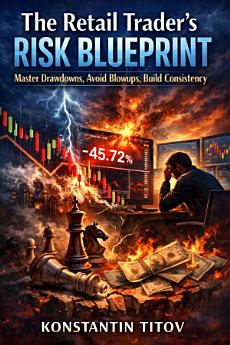
The Retail Trader’s Risk Blueprint gives you a practical, numbers-driven approach to risk that is designed for how you actually trade: imperfect fills, imperfect discipline, and imperfect information. You’ll learn how to think like a risk manager, so you can make decisions that keep you in the game long enough for your edge to matter.
In this book, you’ll discover how to:
- Define a personal risk budget that matches your account size, time horizon, and tolerance for drawdowns, so your plan is built on realistic constraints instead of guesswork
- Size positions with clear formulas and safeguards, including volatility-aware sizing and scenario-based adjustments, so a single trade doesn’t dominate your P&L
- Design stop-loss rules that account for market structure, execution, and slippage, and build a process to reduce “stop moving” behavior under pressure
- Use drawdown and recovery rules to manage losing streaks, reduce risk at the right time, and avoid the common trap of increasing exposure to “make it back”
- Apply probability thinking: expectancy, variance, and risk of ruin concepts that help you evaluate a system beyond a few wins or losses
- Spot hidden account killers such as leverage, margin requirements, correlation, and concentration, so portfolio risk doesn’t quietly compound against you.
You’ll also build the routines that make risk control repeatable: journaling prompts, review cycles, and continuous improvement methods that turn “discipline” into a process you can follow even when emotions run hot.
This book is for you if you trade stocks, options, futures, forex, or crypto and want a structured way to limit damage, understand drawdowns, and develop consistency through better risk decisions.
This book is not for you if you’re looking for a shortcut, a signal service, or a promise of quick profits. It won’t hand you a “perfect strategy.” It will help you build the risk foundation that strategies require to survive.
If you’re ready to stop guessing and start managing risk with clarity, open The Retail Trader’s Risk Blueprint and build the framework your trading has been missing.
Discover more
About the author
Konstantin Titov is a Forex trader, risk architect, and algorithmic systems developer known for his structured, engineering-based approach to retail trading.
With years of focused study in market structure, volatility behavior, leverage mechanics, and capital preservation, Konstantin approaches trading not as prediction—but as controlled exposure management. His work centers on risk engineering, drawdown control, behavioral stabilization, and rule-based execution frameworks designed specifically for retail traders operating with limited capital.
Unlike signal providers or hype-driven educators, he does not sell shortcuts, guarantees, or “perfect strategies.” His philosophy is direct: survival precedes growth, exposure must be engineered, and consistency is built through structure—not excitement.
As the author of multiple books on structured trading, risk control, and retail trader psychology, Konstantin translates professional risk concepts into practical systems that individual traders can realistically apply. His writing reflects a calm, analytical mindset shaped by algorithmic thinking and real-world market experience.
He believes trading success is not built on adrenaline or prediction - it is built on durability, discipline, and intelligent risk control.