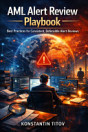
About this ebook
Triage, Investigate, Clear: The Analyst’s Guide
Most AML books explain regulations.
This book explains how to survive the monitoring floor.
AML Alert Disposition Field Manual is a practical, operational guide built for analysts, senior reviewers, QA professionals, and compliance leaders who work inside real transaction monitoring environments — not exam candidates preparing for certification.
This is not regulatory theory.
This is not a summary of FATF guidance.
This is not CAMS exam preparation.
This is about disciplined alert handling under pressure.
Inside high-volume monitoring programs, decisions are made quickly — but they must withstand regulatory scrutiny months later. The difference between a clean closure and a costly escalation error is rarely intelligence. It is structure.
This book teaches analysts how to:
• Triage alerts without missing hidden risk
• Separate data defects from real suspicious behavior
• Build defensible case narratives
• Escalate proportionately and professionally
• Avoid fragile conclusions that fail QA review
• Document decisions that survive hostile reading
• Maintain consistency across high-volume queues
The modern monitoring floor is not quiet. It is driven by metrics, productivity targets, and constant queue pressure. Under those conditions, weak documentation habits form quickly — and those habits surface later during audits, regulatory reviews, or remediation projects.
This manual focuses on execution.
It breaks down:
• Alert intake discipline
• Risk scoping boundaries
• Hypothesis testing under uncertainty
• Evidence hierarchy and documentation standards
• Decision ownership vs. alert processing
• QA defensibility principles
• Escalation triggers and proportional review
Rather than presenting checklists detached from reality, the book walks through realistic monitoring scenarios that reflect the operational tension analysts face every day. The emphasis is clear: a disposition is not a click — it is a professional judgment backed by visible reasoning.
A strong alert review is not about finding something dramatic. It is about proving that what was available was evaluated properly and proportionately.
This book is written for professionals who:
• Work inside transaction monitoring programs
• Review alerts daily under performance pressure
• Lead QA or second-line review functions
• Manage analyst teams
• Design operational monitoring frameworks
It is built as a working manual — designed for desks, not shelves.
When regulators review cases, they do not see your confidence. They see your documentation. When QA scores files, they do not score effort. They score clarity, logic, and defensibility.
This field manual is about mastering that craft.
If Book 1 established operational discipline, and Book 2 structured analytical thinking, Book 3 focuses on execution under pressure - the practical reality of triage, investigation, documentation, and closure.
Because in AML monitoring, the job is not to clear alerts.
The job is to own decisions.
And decisions must stand on their own.
Discover more
About the author
Konstantin Titov is a financial crime operations specialist, systems thinker, and multidisciplinary author focused on Anti-Money Laundering, transaction monitoring architecture, and operational risk discipline.
With professional experience spanning financial markets, algorithmic systems, compliance environments, and applied artificial intelligence, Titov approaches AML from a structural perspective. His work centers on how decisions are built, documented, reviewed, and defended inside real monitoring programs — not how they appear in certification manuals.
Rather than restating regulatory guidance, he writes for professionals working inside high-volume alert environments: analysts, QA reviewers, supervisors, and compliance leaders responsible for maintaining consistency under regulatory scrutiny.
Across his AML series, Titov explores three interconnected dimensions of financial crime operations:
• Operational discipline and ecosystem awareness
• Structured risk reasoning and decision frameworks
• Practical alert disposition, documentation, and escalation craft
His books emphasize clarity over complexity, structure over intuition, and defensibility over speed.
In addition to his work in financial crime operations, Titov has authored multiple books on artificial intelligence systems, structured risk modeling, algorithmic trading psychology, and operational control architecture — all unified by one principle:
Performance improves when systems are designed with discipline.
His books are built as working manuals - designed for desks, not shelves.