About this ebook
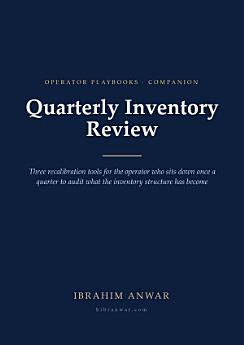
A short, fast-running diagnostic companion to the Operator Playbooks volume on inventory. This is not the full book. It is a quarterly recalibration instrument built on top of it.
The weekly tools detect stock signals as they happen. The quarterly tools do something different: they sit the operator down, once every three months, and audit what has built up underneath the inventory position. Obsolete stock that the books still carry at full value gets written off with a defensible plan. EOQ assumptions get recalibrated against current vendor MOQs and freight terms. Inventory valuation gets reviewed against the fiscal-year close that sophisticated buyers, auditors, and bank credit officers will scrutinize.
A six-question diagnostic intake at the front routes the reader to the right starting tool based on which calibration is most overdue. An operator carrying SKUs from a discontinued product line starts in a different place than one whose vendor just announced a doubled minimum order quantity.
The three tools, each designed to be run once per quarter:
Obsolete-Stock Write-Off Planning. A two-hour structured exercise that identifies stock that no longer earns its shelf position and produces a documented write-off plan defensible to auditors and bank credit officers. Two worked examples: a building materials distributor with discontinued specialty tiles and obsolete pipe fittings, and a medical equipment maintenance workshop in Bandung with parts for a discontinued scanner model.
EOQ Recalibration After Vendor MOQ Change. Run when a vendor changes minimum order quantity, freight terms, or unit pricing structure. Reconstructs the economic order quantity against current carrying cost and stockout risk, then produces a counter-proposal if the new MOQ is structurally unworkable. Two worked examples: a food service distributor responding to a packaging supplier's MOQ shift, and a multi-branch auto parts wholesaler in Bekasi-Bogor-Karawang where the new MOQ turned out to be cheaper per unit than the old.
Fiscal-Year Inventory Valuation Review. Run before the fiscal close, this tool reconciles book inventory against physical count and against the valuation method actually defensible at audit. Two worked examples: a consumer goods distributor with three warehouses managing a FIFO breakdown, and a hardware wholesale distributor in East Java handling a consignment-shelf accounting edge case.
Each tool carries a self-scoring rubric, a quick decision tree, and tier adaptations for single-owner shops, mid-tier businesses, and pre-IPO operations. A quarterly plan at the back sequences the three tools across one full quarter so the recalibration discipline forms without overload.
This companion was written from the seat of an operator running businesses in Indonesia. Examples, currency, and texture reflect that origin. The frameworks apply broadly to small and mid-sized businesses in other emerging markets and to many developed-market SME settings.
What this companion does NOT do
Replace Inventory Optimization Techniques (Operator Playbooks 03).
Substitute for the weekly-rhythm tools.
Address scenario-triggered crisis-response inventory work; that lives in the Inventory Under Pressure companion.
Who This Is For
Operators running the weekly inventory checks who now need quarterly recalibration.
Owners with vendor MOQ changes, valuation questions, or obsolete-stock build-up.
Mid-tier directors heading into a fiscal-year close, audit, or bank credit review.
Topics and Keywords
quarterly inventory review, obsolete stock write-off, EOQ recalibration, vendor MOQ change, inventory valuation, fiscal-year close, audit-defensible inventory, SME inventory recalibration, operator playbook companion
Discover more
Ratings and reviews
About the author
Ibrahim Anwar, known as Hibranwar, is an entrepreneur and writer at the intersection of engineering, business, and content. Dutch Literature from Universitas Indonesia. He runs operating businesses across industrial pump distribution, engineering services, and handmade leather craft, and writes from the seat of the operator. ORCID 0009-0006-0425-4923.