About this ebook
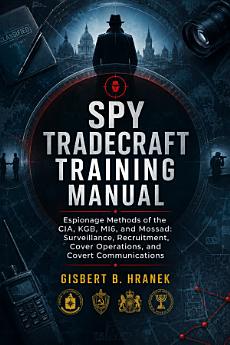
Behind every headline about a captured mole, a defected officer, or a Cold War close call lies a training system decades in the making — one built to answer a single question: can this person be trusted with secrets that could cost lives? Spy Tradecraft Training Manual pulls back the curtain on that system, tracing the espionage methods of the CIA, KGB, MI6, and Mossad across twelve deeply researched chapters that take you from recruitment to the modern cyber battlefield.
This isn't a rehash of one agency's Cold War playbook. It's a comprehensive, comparative field guide that shows you how four of history's most formidable intelligence services each solved the same problems — recruitment, tradecraft, surveillance, cryptography — in radically different ways, shaped by radically different societies. You'll meet the real people behind the methodology: Tony Mendez, the CIA's master of disguise who exfiltrated diplomats from Tehran; Kim Philby, the MI6 officer whose ideological betrayal reshaped Western intelligence vetting forever; Eli Cohen, the Mossad legend who infiltrated the highest levels of the Syrian government; and Oleg Kalugin, the KGB general whose academic fast-track into foreign intelligence became a textbook case of Soviet recruitment doctrine.
Inside, you'll learn:
✓ How intelligence services spot, assess, and recruit agents — and why coercion is the least reliable motivation of all
✓ The real mechanics of surveillance and counter-surveillance, from rotating mobile teams to the patient discipline of a surveillance detection route
✓ How cover identities and legends are built to survive years of scrutiny — and what happens when one is finally blown
✓ The evolution of secret communications, from the one-time pad and Cold War numbers stations to modern digital encryption
✓ The doctrine shift behind interrogation and resistance training, including why coercive methods were abandoned in favor of rapport-based technique
✓ How influence operations and active measures shaped public opinion for decades — and how the same playbook runs at digital speed today
✓ Why cyber espionage and open-source intelligence have transformed tradecraft for a generation of officers who may never set foot in the country they're targeting
Every chapter is grounded in the public historical record — declassified files, officer memoirs, and documented case studies — and written to be read by anyone curious about how espionage actually works, not just industry insiders. Whether you're a history buff, a thriller writer researching authentic tradecraft, a student of international relations, or simply someone who's always wondered what separates a good cover story from a fatal mistake, this book delivers the depth competitors only skim.
You've read about the world's most famous spies. Now discover the training that made them. Scroll up and click "Buy Now" to start your own tradecraft education today.
Discover more
About the author
Gisbert B. Hranek is an independent researcher and writer with a long-standing interest in the history and organizational practice of intelligence agencies. Drawing on declassified archives, officer memoirs, and decades of published historical scholarship, Hranek's work focuses on making the documented history of espionage tradecraft accessible to general readers without sacrificing accuracy or nuance.