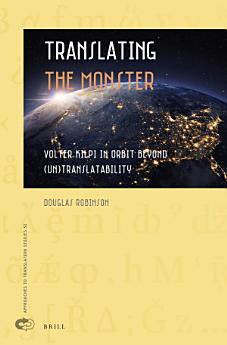
Translating the Monster: Volter Kilpi in Orbit Beyond (Un)translatability
Oct 2022 · BRILL
Ebook
308
Pages
Tools
info
About this ebook
One of the hottest battles emerging out of the theoretical and methodological collisions between Comparative Literature and Translation Studies—especially on the battleground of World Literature—has to do with translatability and untranslatability. Is any translation of a great work of literature not only a lamentable betrayal but an impossibility? Or is translation an imperfect but invaluable tool for the transmission of works and ideas beyond language barriers?
Both views are defensible; indeed both are arguably commonsensical. What Douglas Robinson argues in Translating the Monster, however, is that both are gross oversimplifications of a complex situation that he calls on Jacques Derrida to characterize as “the monster.”
The Finnish novelist Robinson takes as his case study for that monstrous rethinking is Volter Kilpi (1874-1939), regarded by scholars of Finnish literature as Finland’s second world-class writer—the first being Aleksis Kivi (1834-1872). Kilpi’s modernist experiments of the 1930s, especially his so-called Archipelago series, beginning with his masterpiece, In the Alastalo Parlor (1933), were forgotten and neglected for a half century, due to the extreme difficulty of his narrative style: he reinvents the Finnish language, to the extent that many Finns say it is like reading a foreign language (and one contemporary critic called it the “Mesopotamian language ... of a half-wit”). That novel has been translated exactly twice, into Swedish and German. Translating the Monster also gives the English-speaking reader an extended taste of the novel in English—en route to a series of reframings of the novel as allegories of translation and world literature.
Both views are defensible; indeed both are arguably commonsensical. What Douglas Robinson argues in Translating the Monster, however, is that both are gross oversimplifications of a complex situation that he calls on Jacques Derrida to characterize as “the monster.”
The Finnish novelist Robinson takes as his case study for that monstrous rethinking is Volter Kilpi (1874-1939), regarded by scholars of Finnish literature as Finland’s second world-class writer—the first being Aleksis Kivi (1834-1872). Kilpi’s modernist experiments of the 1930s, especially his so-called Archipelago series, beginning with his masterpiece, In the Alastalo Parlor (1933), were forgotten and neglected for a half century, due to the extreme difficulty of his narrative style: he reinvents the Finnish language, to the extent that many Finns say it is like reading a foreign language (and one contemporary critic called it the “Mesopotamian language ... of a half-wit”). That novel has been translated exactly twice, into Swedish and German. Translating the Monster also gives the English-speaking reader an extended taste of the novel in English—en route to a series of reframings of the novel as allegories of translation and world literature.
One of the hottest battles emerging out of the theoretical and methodological collisions between Comparative Literature and Translation Studies—especially on the battleground of World Literature—has to do with translatability and untranslatability. Is any translation of a great work of literature...
About the author
Douglas Robinson, Professor of Translation Studies at the Chinese University of Hong Kong, Shenzhen, took his 1983 Ph.D. in English at the University of Washington (Seattle). Among his dozen book-length literary translations from Finnish, two dozen monographs, and five dozen articles are Aleksis Kivi and/as World Literature (Brill 2017) and translations of Kivi’s The Brothers Seven (2017) and Volter Kilpi’s Gulliver’s Voyage to Phantomimia (2020).
Douglas Robinson, Professor of Translation Studies at the Chinese University of Hong Kong, Shenzhen, took his 1983 Ph.D. in English at the University of Washington (Seattle). Among his dozen book-length literary translations from Finnish, two dozen monographs, and five dozen articles are Aleksis ...
Rate this ebook
Tell us what you think.
Reading information
Smartphones and tablets
Install the Google Play Books app for Android and iPad/iPhone. It syncs automatically with your account and allows you to read online or offline wherever you are.
Laptops and computers
You can listen to audiobooks purchased on Google Play using your computer's web browser.
eReaders and other devices
To read on e-ink devices like Kobo eReaders, you'll need to download a file and transfer it to your device. Follow the detailed Help Center instructions to transfer the files to supported eReaders.