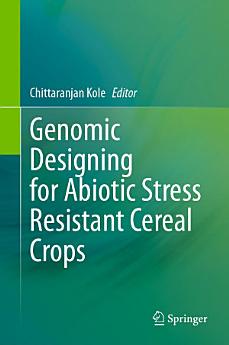
Genomic Designing for Abiotic Stress Resistant Cereal Crops

· Springer Nature
Ebook
317
Pages

About this ebook

This book presents abiotic stresses that cause crop damage in the range of 6-20%. Understanding the interaction of crop plants to the abiotic stresses caused by heat, cold, drought, flooding, submergence, salinity, acidity, etc., is important to develop resistant crop varieties. Knowledge on the advanced genetic and genomic crop improvement strategies including molecular breeding, transgenics, genomic-assisted breeding, and the recently emerging genome editing for developing resistant varieties in cereal crops is imperative for addressing FPNEE (food, health, nutrition, energy, and environment) security. Whole genome sequencing of these crops followed by genotyping-by-sequencing has facilitated precise information about the genes conferring resistance useful for gene discovery, allele mining, and shuttle breeding which in turn opened up the scope for 'designing' crop genomes with resistance to abiotic stresses.

The nine chapters each dedicated to a cereal crop in this volumeare deliberate on different types of abiotic stresses and their effects on and interaction with crop plants; enumerate on the available genetic diversity with regard to abiotic stress resistance among available cultivars; illuminate on the potential gene pools for utilization in interspecific gene transfer; are brief on the classical genetics of stress resistance and traditional breeding for transferring them to their cultivated counterparts; elucidate on the success stories of genetic engineering for developing abiotic stress-resistant crop varieties; discuss on molecular mapping of genes and QTLs underlying stress resistance and their marker-assisted introgression into elite varieties; enunciate on different emerging genomics-aided techniques including genomic selection, allele mining, gene discovery, and gene pyramiding for developing adaptive crop varieties with higher quantity and quality, and also elaborate some case studies on genome editing focusing on specific genes for generating abiotic stress-resistant crops.
This book presents abiotic stresses that cause crop damage in the range of 6-20%. Understanding the interaction of crop plants to the abiotic stresses caused by heat, cold, drought, flooding, submergence, salinity, acidity, etc., is important to develop resistant crop varieties. Knowledge on the ...

Discover more

About the author

Prof. Chittaranjan Kole is an internationally reputed scientist with an illustrious professional career spanning over twenty-six years and original contributions in the fields of plant genomics and biotechnology leading to the publication of more than 150 research articles in globally leading journals. He has edited over 125 books for the leading publishers of the world including Springer Nature, Wiley-Blackwell and Taylor & Francis Group. His works and editing acumen have been appreciated by seven Nobel Laureates including Profs. Norman Borlaug, Arthur Kornberg, Werner Arber, Phillip Sharp, Günter Blobel, Lee Hartwell and Roger Kornberg. He is also in the editorial boards of BMC Genomics, International Journal for Plant Genomics, Euphytica, and Plant Genetic Resources amongst many others. Previously he was a Visiting Professor in The Pennsylvania State University and Clemson University. He also served as the Vice-Chancellor of the BC Agricultural University in India. He is alsothe Principal Coordinator of the International Climate-Resilient Crop Genomics Consortium (ICRCGC) and International Consortium for Phytomedomics and Nutriomics (ICPN).
Prof. Chittaranjan Kole is an internationally reputed scientist with an illustrious professional career spanning over twenty-six years and original contributions in the fields of plant genomics and biotechnology leading to the publication of more than 150 research articles in globally leading jou...

Rate this ebook

Tell us what you think.

Reading information

Smartphones and tablets
Install the Google Play Books app for Android and iPad/iPhone. It syncs automatically with your account and allows you to read online or offline wherever you are.
Laptops and computers
You can listen to audiobooks purchased on Google Play using your computer's web browser.
eReaders and other devices
To read on e-ink devices like Kobo eReaders, you'll need to download a file and transfer it to your device. Follow the detailed Help Center instructions to transfer the files to supported eReaders.