Artificial Intelligence for Pharmaceutical Sciences
About this ebook series
AI IN PHARMA: FROM LITERATURE TO REGULATORY, A PRACTICAL SERIES
If you are a pharmaceutical scientist, you have likely felt the mismatch: AI tools promise to speed up your work, but the reward can be a fabricated citation, a docking score that fails in the lab, or a model that looks great until the auditor asks for validation. Is there a way to use AI without losing your scientific judgment?
Yes. And it does not require learning to code or becoming a machine-learning engineer. It requires a structured approach that treats AI as a decision-support tool, not a magic oracle.
That is exactly what this three-book series delivers. Each volume is practical, vendor-neutral, and built around validation, transparency, and human oversight. Together, they trace the entire pharmaceutical lifecycle, from the first literature search to the final regulatory submission.
🔹 AI for Pharmaceutical Research: Using Artificial Intelligence for Literature Analysis, Scientific Reasoning, and Research Workflows
This first book gives you a verification-first system for the daily research grind. You will learn how to use specific tools like PubMed, Google Scholar, ChatGPT, Claude, NotebookLM, Elicit, Zotero, and spreadsheets as a disciplined drafting assistant. It includes checklists to catch hallucinations, and real pharma examples like curcumin bioavailability and solid dispersions. It is organized into five parts that mirror the research lifecycle, so you can jump straight to the phase you are facing, whether that is framing a research question or drafting a manuscript. If you are a student, lecturer, or R&D scientist drowning in PDFs, start here.
🔹 AI for Drug Discovery and Molecular Design: Using Artificial Intelligence from Target Identification to Lead Optimization
The second book steps into the discovery pipeline. It explains how molecules and proteins are encoded, when to trust predictive models for QSAR, ADMET, and activity, and how to use docking, AlphaFold, and generative AI without fooling yourself. With 24 chapters and six parts, it covers everything from molecular representations to integrated workflows, and it requires no coding or advanced math. Each chapter closes with a validation takeaway and a candid look at limitations. This is for medicinal chemists and researchers who want to turn computational predictions into testable hypotheses, not just colorful plots.
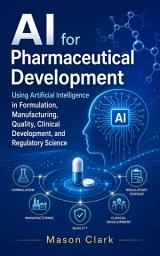
🔹 AI for Pharmaceutical Development: Using Artificial Intelligence in Formulation, Manufacturing, Quality, Clinical Development, and Regulatory Science
The third book moves to the later stages. It maps AI to formulation, QbD/DoE, PAT, stability, deviation investigation, clinical trial monitoring, regulatory writing, and pharmacovigilance. It includes step-by-step workflows, decision matrices, and compliance checkpoints that you can apply immediately. It is grounded in GMP and data integrity, with explicit checkpoints for compliance and human oversight. If you work in a regulated environment and need to deploy AI responsibly, this is your guide.
What makes the series work is the consistency. Every book uses the same philosophy: AI proposes, you dispose—with evidence. No black-box mysticism, no overblown claims. Each volume is written for scientists, not programmers; examples use familiar pharma language and real scenarios.
Whether you are just starting your career or leading a team, this series gives you a roadmap to adopt AI with confidence. Pick the book that matches your current stage, but consider reading all three to see how the pieces connect. The result is a complete, honest picture of what AI can and cannot do across the drug lifecycle.
#AI #PharmaceuticalResearch #DrugDiscovery #PharmaDevelopment #PracticalAI #ResponsibleAI
#AI #PharmaceuticalResearch #DrugDiscovery #PharmaDevelopment #PracticalAI #ResponsibleAI