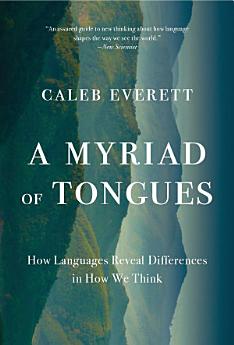
A Myriad of Tongues: How Languages Reveal Differences in How We Think
Sep 2023 · Harvard University Press
Ebook
288
Pages
Tools
info
About this ebook
"An assured guide" (New Scientist) to the relationship between the language we speak and our perception of such fundamentals of experience as time, space, color, and smells.
We tend to assume that all languages categorize ideas and objects similarly, reflecting our common human experience. But this isn’t the case. When we look closely, we find that many basic concepts are not universal, and that speakers of different languages literally see and think about the world differently.
Caleb Everett takes readers around the globe, explaining what linguistic diversity tells us about human culture, overturning conventional wisdom along the way. For instance, though it may seem that everybody refers to time in spatial terms—in English, for example, we speak of time “passing us by”—speakers of the Amazonian language Tupi Kawahib never do. In fact, Tupi Kawahib has no word for “time” at all. And while it has long been understood that languages categorize colors based on those that speakers regularly encounter, evidence suggests that the color words we have at our disposal affect how we discriminate colors themselves: a rose may not appear as rosy by any other name. What’s more, the terms available to us even determine the range of smells we can identify. European languages tend to have just a few abstract odor words, like “floral” or “stinky,” whereas Indigenous languages often have well over a dozen.
Why do some cultures talk anthropocentrically about things being to one’s “left” or “right,” while others use geocentric words like “east” and “west”? What is the connection between what we eat and the sounds we make? A Myriad of Tongues answers these and other questions, yielding profound insights into the fundamentals of human communication and experience.
"An assured guide" (New Scientist) to the relationship between the language we speak and our perception of such fundamentals of experience as time, space, color, and smells.
We tend to assume that all languages categorize ideas and objects similarly, reflecting our common human experience. But ...
About the author
Caleb Everett, Professor of Anthropology and of Linguistics and Cognitive Science and Dean of the College of Arts & Sciences at the University of Delaware, is the author of Numbers and the Making of Us and Linguistic Relativity: Evidence across Languages and Cognitive Domains.
Caleb Everett, Professor of Anthropology and of Linguistics and Cognitive Science and Dean of the College of Arts & Sciences at the University of Delaware, is the author of Numbers and the Making of Us and Linguistic Relativity: Evidence across Languages and Cognitive Domains.
Rate this ebook
Tell us what you think.
Reading information
Smartphones and tablets
Install the Google Play Books app for Android and iPad/iPhone. It syncs automatically with your account and allows you to read online or offline wherever you are.
Laptops and computers
You can listen to audiobooks purchased on Google Play using your computer's web browser.
eReaders and other devices
To read on e-ink devices like Kobo eReaders, you'll need to download a file and transfer it to your device. Follow the detailed Help Center instructions to transfer the files to supported eReaders.