About this ebook
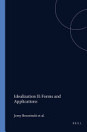
Discussions about abstraction are so important and so profound that this topic can hardly be neglected. It has inevitably cropped up again in various periods of philosophical enquiry. Despite these ancient roots and after the great debate that characterised the empirical and rationalistic tradition, interest in the problem has unfortunately been absent in large measure from the mainstream of mathematical logic and analytic philosophy. It seems that there is a gap between the epistemological theorization, in which it is difficult to find new insights on the problem of abstraction, and the historical studies concerning the development of philosophical thought. Such studies, however, present a more fertile ground for such insights. Here the reader will find presented for the first time a collection of papers about the topic, considered from an historical point of view together with an awareness of the need for building a bridge between historical research and theoretical speculation. Accordingly the volume consists of both general overviews which sketch the signifcance and the fortunes of abstraction in science, philosophy and logic (the first part) and historical case studies which focus on abstraction in particular thinkers (the second part). This volume is of interest for both general philosophers and historians of philosophy.
Discussions about abstraction are so important and so profound that this topic can hardly be neglected. It has inevitably cropped up again in various periods of philosophical enquiry. Despite these ancient roots and after the great debate that characterised the empirical and rationalistic traditi...
Discover more
About the author
Francesco Coniglione (1949) teaches history of philosophy at Catania University and is member of the Advisory Committee of the Poznań Studies on the Philosophy of the Sciences and the Humanities. He has studied Polish analytical philosophy (Nel segno della scienza. La filosofia polacca del Novecento, Milano 1996), and the history of the 20th century philosophy of science (La parola liberatrice. Momenti storici del rapporto tra filosofia e scienza, Catania 2002). He has published numerous papers, some of which are translated into English and Polish.
Roberto Poli (1955) teaches at the Faculty of Sociology of Trento University and is editor-in-chief of Axiomathes (Kluwer). Poli is member of the Board of directors of Mitteleuropa Foundation (Bolzano) and editor of Categories (Poligraphica), Western Philosophy Series (Ashgate), and Dialogikon (Jagiellonian University, Cracow). His main scientific interests include ontology (Ontologia formale, Genova 1992), Central European Philosophy (Brentano, Husserl, Meinong, Twardowski) and the theory of values; His works are published in English, German, Italian, Polish, and Russian. He is currently working on the elaboration of the general categorical framework for an ontology well suited for applications in the field of information sciences (ALWIS. Ontology for Knowledge Engineers, Utrecht, 2001).
Robin D. Rollinger (1956) is a research editor at the Husserl Archives in Leuven. He is the main editor of Husserliana XXXVI (Transzendentaler Idealismus) and is currently working on another critical edition of the Husserliana (Urteilstheorie). He has also written two books, Meinong and Husserl on Abstraction and Universals (1993) and Husserl’s Position in the School of Brentano (1999), as well as numerous articles on phenomenology, Austrian philosophy, and the nineteenth century background of these currents.
Francesco Coniglione (1949) teaches history of philosophy at Catania University and is member of the Advisory Committee of the Poznań Studies on the Philosophy of the Sciences and the Humanities. He has studied Polish analytical philosophy (Nel segno della scienza. La filosofia polacca del Novece...
Rate this ebook
Tell us what you think.
Reading information
Smartphones and tablets
Install the Google Play Books app for Android and iPad/iPhone. It syncs automatically with your account and allows you to read online or offline wherever you are.
Laptops and computers
You can listen to audiobooks purchased on Google Play using your computer's web browser.
eReaders and other devices
To read on e-ink devices like Kobo eReaders, you'll need to download a file and transfer it to your device. Follow the detailed Help Center instructions to transfer the files to supported eReaders.