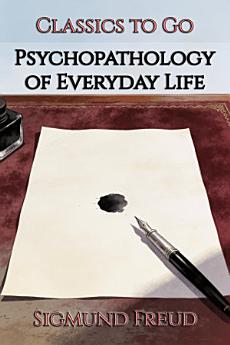
Psychopathology of Everyday Life: Restored Classics to Go Edition

· Otbebookpublishing
Ebook
285
Pages
Eligible

About this ebook

Sigmund Freud's Psychopathology of Everyday Life turns ordinary mistakes into evidence of hidden mental life, arguing that slips, forgetfulness, and clumsy actions are never merely random. In A. A. Brill's framing, Freud shows that the same forces behind neurosis operate in everyday people, making trivial errors meaningful acts shaped by repression, conflict, and unconscious association. Freud begins with forgotten names, especially his famous failure to recall "Signorelli," where substitute names like Botticelli and Boltraffio reveal the path of displaced thought. He then broadens the inquiry to foreign words, misquotations, and broken verses, including the lapse on "aliquis," which leads to a private anxiety about a woman's missed period, and other examples in which poetry falters under grief, fear, or self-censorship. The book then moves into erroneous actions: missed turns, misplaced objects, and repeated gestures that expose wishes to belong, ambitions, guilt, and self-criticism. Across these cases, Freud presents everyday error as a coded psychological event, governed by hidden laws rather than chance. This edition has been fully restored with modern typesetting, custom cover design.
Sigmund Freud's Psychopathology of Everyday Life turns ordinary mistakes into evidence of hidden mental life, arguing that slips, forgetfulness, and clumsy actions are never merely random. In A. A. Brill's framing, Freud shows that the same forces behind neurosis operate in everyday people, makin...

About the author

Sigmund Freud, born in 1856 in what is now the Czech Republic and later based in Vienna, was a neurologist whose restless curiosity helped transform modern ideas about the mind. Trained in medicine, he moved from laboratory research to clinical practice and gradually developed psychoanalysis, a new way of understanding human behavior through the hidden forces of the unconscious, memory, desire, dreams, and conflict. His writings, lectures, and case studies made him one of the most influential intellectual figures of the twentieth century, shaping not only psychology and psychiatry but also literature, art, philosophy, and the broader language people still use to talk about themselves. Across his work, Freud explored repression, childhood experience, sexuality, anxiety, slips of speech, and the uneasy gap between what people say and what they feel, arguing that ordinary life is often shaped by forces beneath awareness. Those ideas remain relevant today because they continue to inform conversations about trauma, self-knowledge, identity, and the complexity of human motivation, even as many of his theories are debated or revised. Freud's legacy lies less in offering final answers than in opening a lasting inquiry into the hidden life of the psyche, and readers interested in the origins of modern psychology, the mysteries of behavior, or the deep connections between culture and inner life will find him especially rewarding.
Sigmund Freud, born in 1856 in what is now the Czech Republic and later based in Vienna, was a neurologist whose restless curiosity helped transform modern ideas about the mind. Trained in medicine, he moved from laboratory research to clinical practice and gradually developed psychoanalysis, a n...

Rate this ebook

Tell us what you think.

Reading information

Smartphones and tablets
Install the Google Play Books app for Android and iPad/iPhone. It syncs automatically with your account and allows you to read online or offline wherever you are.
Laptops and computers
You can listen to audiobooks purchased on Google Play using your computer's web browser.
eReaders and other devices
To read on e-ink devices like Kobo eReaders, you'll need to download a file and transfer it to your device. Follow the detailed Help Center instructions to transfer the files to supported eReaders.