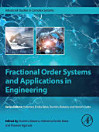
Recent Trends in Fractional Calculus and Its Applications

· ·
· Elsevier
Ebook
320
Pages
Eligible

About this ebook

Recent Trends in Fractional Calculus and Its Applications addresses the answer to this very basic question: "Why is Fractional Calculus important?" Until recent times, Fractional Calculus was considered as a rather esoteric mathematical theory without applications, but in the last few decades there has been an explosion of research activities on the application of Fractional Calculus to very diverse scientific fields ranging from the physics of diffusion and advection phenomena, to control systems to finance and economics. An important part of mathematical modelling of objects and processes is a description of their dynamics.The term Fractional Calculus is more than 300 years old. It is a generalization of the ordinary differentiation and integration to noninteger (arbitrary) order. The subject is as old as the calculus of differentiation and goes back to times when Leibniz, Gauss, and Newton invented this kind of calculation. Several mathematicians contributed to this subject over the years. People like Liouville, Riemann, and Weyl made major contributions to the theory of Fractional Calculus. In recent decades the field of Fractional Calculus has attracted the interest of researchers in several areas, including mathematics, physics, chemistry, engineering, finance, and social sciences. - Provides the most recent and up-to-date developments in the Fractional Calculus and its application areas - Presents pre-preparation ideas to help researchers/scientists/clinicians face the new challenges in the application of fractional differential equations - Helps researchers and scientists understand the importance of the Fractional Calculus to solve many problems in Biomedical Engineering and applied sciences
Recent Trends in Fractional Calculus and Its Applications addresses the answer to this very basic question: "Why is Fractional Calculus important?" Until recent times, Fractional Calculus was considered as a rather esoteric mathematical theory without applications, but in the last few decades the...

Discover more

About the author

Dr. Praveen Agarwal earned his Ph. D. in Mathematics at the Malviya National Institute of Technology (MNIT) in Jaipur, India, in 2006. Recently, Prof. Agarwal has been listed as the World's Top 2% Scientist from 2020-2025, released by Stanford University. In the 2025 ranking of best scientists worldwide announced by Research.com, he ranked 13th at the India level and 1297th worldwide in Mathematics. Dr. Agarwal has been actively involved in research as well as pedagogical activities for the last 24 years. His major research interests include Special Functions, Fractional Calculus, Numerical Analysis, Differential and Difference Equations, Inequalities, Probability & Statistics, and Fixed Point Theorems. He has published 11 research monographs and edited volumes and more than 405 publications (with almost 100 mathematicians all over the world) in prestigious national and international mathematics journals. Dr. Agarwal worked previously either as a regular faculty or as a visiting professor and scientist in universities in several countries, including India, Germany, Turkey, South Korea, UK, Russia, Malaysia and Thailand. He has served over 50 Journals in the capacity of an Editor/Honorary Editor, or Associate Editor, and published 15 books as an editor.

Dr. Luis Vázquez Martínez is Professor Emeritus of Applied Mathematics Departamento de Matématica Aplicada, Faculdad do Informática, Universidad Complutense de Madrid, Spain. Dr. Martínez has held many distinguished administrative positions throughout his career, including Vice-Dean of Research, External Relations and Students of Facultad de Ciencias Físicas, Academic Director of Research at UCM, and Director and Founder of the European Office of Research and the Supercomputing Center, UCM, among many others. Dr. Martínez has received many awards and research honors during his distinguished career, including the Daza Valdés Prize from the Spanish Society of Optica, Cavaliere dell’Ordine della Stella from the Republic of Italy, NASA Distinction as Principal Investigator of REMS-Curiosity-MSL, and the Liouville Award for Lifetime Achievements in the Area of Fractional Calculus and Its Applications. Dr. Martínez was a Founding Member of the Centre of Astrobiology associated with NASA in its Mars exploration program, where he founded and managed the Advanced Computer Laboratory.

Dr. Ervin K. Lenzi is Associate Professor of Physics at Universidade Estaudal de Ponta Grossa, Brazil. Dr. Lenzi has a Ph.D. in Physics from Centro Brasileiro de Pesquisas Física, and was a Postdoc Fellow in Physics at Politecnico di Torino, Italy. His research interests include Diffusive Processes, Complex Systems, and Applications of the Diffusion Equation. Dr. Lenzi is on the Editorial Board of Journal of Geophysics and Engineering, Mathematical Problems in Engineering, and Quantum Reports.
Dr. Praveen Agarwal earned his Ph. D. in Mathematics at the Malviya National Institute of Technology (MNIT) in Jaipur, India, in 2006. Recently, Prof. Agarwal has been listed as the World's Top 2% Scientist from 2020-2025, released by Stanford University. In the 2025 ranking of best scientists wo...

Rate this ebook

Tell us what you think.

Reading information

Smartphones and tablets
Install the Google Play Books app for Android and iPad/iPhone. It syncs automatically with your account and allows you to read online or offline wherever you are.
Laptops and computers
You can listen to audiobooks purchased on Google Play using your computer's web browser.
eReaders and other devices
To read on e-ink devices like Kobo eReaders, you'll need to download a file and transfer it to your device. Follow the detailed Help Center instructions to transfer the files to supported eReaders.