About this ebook
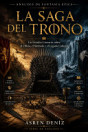
The Throne Saga: A Literary Study of Craft, Symbol, and Cultural Legacy explores the narrative machinery behind one of modern epic fantasy's most influential forms of storytelling—not by retelling the plot, but by examining the craft, ideas, and structural choices that make such a vast fictional world compelling.
Asren Deniz approaches the saga as a literary laboratory where power, morality, character, history, myth, and narrative technique constantly intersect.
At the heart of the study lies one fundamental question: What is power, and what does it cost to possess it?
The book examines competing models of political authority, from lineage and wealth to military force and popular loyalty. Rather than treating the struggle for a throne as a simple conflict between heroes and villains, it explores how legitimacy is constructed, challenged, and destroyed.
Character development forms another major part of the analysis. Heroes can fail. Villains can reveal understandable motivations. Mentors can disappear before their lessons are complete. Characters who initially seem honorable may make disastrous decisions, while deeply flawed figures can become surprisingly sympathetic.
This moral uncertainty transforms the reader from a passive observer into an active interpreter.
The study then turns to worldbuilding.
Geography, climate, history, religion, economics, mythology, and political institutions are examined as interconnected systems rather than decorative background. The result offers valuable lessons for aspiring writers interested in creating fictional worlds that feel as though they existed long before the first page of the story.
Particular attention is also given to the use of multiple points of view. By allowing different characters to experience the same world through limited perspectives, epic fantasy can challenge the idea that any single character possesses the complete truth.
The book also explores the saga's mythic layer: winter, fire and ice, prophecy, forgotten legends, and the gradual return of supernatural forces. These elements reveal how fantasy can combine intimate political struggles with threats operating on a far larger historical and mythological scale.
Other chapters examine the challenges of adapting sprawling fantasy literature for the screen, the relationship between dialogue and characterization, the importance of pacing, and the cultural influence of morally complex fantasy storytelling.
Inside this literary study:
• The anatomy of power and political legitimacy
• Character arcs and moral gray areas
• Worldbuilding through geography, history, religion, and economics
• Multi-POV storytelling and limited perspective
• Symbolism, winter, prophecy, fire, and ice
• The relationship between politics and mythology
• From page to screen: the challenges of adaptation
• Dialogue, voice, and characterization
• Pacing, tension, and structural rhythm
• Grimdark and the evolution of modern epic fantasy
• Cultural impact and genre legacy
• Practical craft lessons for aspiring fantasy writers
The Throne Saga is written for readers who want to look beyond the surface of epic fantasy and understand the storytelling architecture underneath it.
Whether you are a fantasy reader, an aspiring novelist, a worldbuilder, or simply fascinated by the mechanics of ambitious long-form storytelling, this book offers a structured examination of how complex fantasy worlds are built, populated, and brought to life.
Independent Analysis Notice: This book is an independent work of literary criticism and commentary. It is not affiliated with, endorsed by, or officially connected to the work under discussion, its author, publisher, or television adaptation.