Archiv für Begriffsgeschichte. Band 56

· ·
· Felix Meiner Verlag
Ebook
259
Pages
Eligible

About this ebook

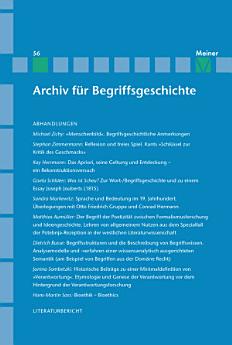
Abstracts Michael Zichy: »Menschenbild«. Begriffsgeschichtliche Anmerkungen The German term ›Menschenbild‹, which, in its modern sense, might be translated as (public) understanding of human nature, is very popular both in public and in academic discourse. There is widespread consensus that ›Menschenbilder‹ are fundamental to human selfunderstanding and the organisation of society. This paper examines the history of this concept and follows the multiple changes of its meaning that have occurred between the middle ages and today. Stephan Zimmermann: Reflexion und freies Spiel. Kants »Schlüssel zur Kritik des Geschmacks« As the »key to the critique of taste« in §9 of his Critique of Judgement Kant offers the well-known doctrine of a »free play of the cognitive faculties«. What exactly this play consists in is still much discussed in the literature. Kant describes it as a state of harmony between imagination and understanding, for which the reflecting judgement, which mediates between the two, is responsible. This paper turns against the popular interpretation that considers »free play« as an exceptional state of the mind in which the said faculties are relieved from their actual cognitive activity. This view, however, creates a number of inconsistencies. Above all, Kant explicitly speaks against it. The paper therefore argues for an alternative reading that is able to take these objections into account. Kay Herrmann: Das Apriori, seine Geltung und Entdeckung – ein Rekonstruktionsversuch The problem of synthetic judgments touches upon the question whether philosophy is in fact capable of making independent truth statements. According to Kant, synthetic judgments formulate the conditions for the possibility of objectively valid knowledge a priori. As far as empirical attempts at reinterpretation of the aprioristic fall short of this ambition, Kant's a priori goes deeper. This is because modern science strives towards objective knowledge, although its statements are fundamentally fallible. The topic of synthetic a priori thus continues to be relevant. This paper will show that, in order to be viable at all, a modernized version of transcendental philosophy must ›depart from‹ the concepts of »independence from empirics« and/or the »purity« of the aprioristic. Kant's reflections on nonpure synthetic a priori knowledge already contain attempts at this. Furthermore, the aprioristic validity of knowledge does not exclude the possibility, that it can be discovered empirically. Fries and, subsequently, Nelson proceeded with this separation (initially ascribed to Reichenbach) between the contexts of validity and discovery of knowledge, pointing out that the a priori can indeed be discovered empirically, yet never be proven. Currently, there are still a number of valid reasons for arguing that concepts from transcendental philosophy (space, time, substance, causality, freedom and the distinction between the noumenal and phenomenal worlds) continue to be of fundamental importance for the modern sciences. However, it must not be neglected that, even within a modernized framework of transcendental philosophy various unsolved problems remain and/or are created (such as the unfeasibility of the aprioristic claim to general validity and necessity, the problem of drawing a clear boundary between the noumenal and phenomenal worlds). Moreover, the »beautiful structure« of the Kantian system, which constitutes much of its persuasive strength, is lost. Gisela Schlüter: Was ist Scheu? Zur Wort-/Begriffsgeschichte und zu einem Essay Joseph Jouberts (1815) ›Shame‹/›Scham‹ has recently been dealt with in diverse contexts. This paper focuses on ›shyness‹/›Scheu‹=›Schamhaftigkeit‹/›pudeur‹ corresponding to ›aidos‹ and ›verecundia‹, retracing the history of the concept in German, French, Italian, and English language.
Abstracts Michael Zichy: »Menschenbild«. Begriffsgeschichtliche Anmerkungen The German term ›Menschenbild‹, which, in its modern sense, might be translated as (public) understanding of human nature, is very popular both in public and in academic discourse. There is widespread consensus that ›Mens...

About the author

Prof. Dr. Christian Bermes ist Leiter des Instituts für Philosophie an der Universität Koblenz-Landau. Sprecher des Forschungsschwerpunkts ›Kulturelle Orientierung und normative Bindung‹ und der Graduiertenschule ›Herausforderung Leben‹, Mitherausgeber des ›Archiv für Begriffsgeschichte‹, Vizepräsident der Deutschen Gesellschaft für phänomenologische Forschung. Arbeitsschwerpunkte: Phänomenologie, Sprachphilosophie, Philosophische Anthropologie, Kulturphilosophie, Moralphilosophie.

Ulrich Dierse war Kustos am Historischen Wörterbuch der Philosophie. Er ist Mitherausgeber des Archivs für Begriffsgeschichte und Akademischer Rat i. R. an der Universität Bochum.

Michael Erler (*14. August 1953 in Köln) ist ein deutscher Altphilologe, der derzeit an der Julius-Maximilians-Universität Würzburg lehrt. Ab 1972 studierte Erler Mathematik, Physik und Philosophie, ab 1973 Altgriechisch und Latein an der Universität zu Köln. Unterbrochen von einem Aufenthalt am University College London, schloss Erler 1977 sein Magisterstudium als Stipendiat der Studienstiftung des deutschen Volkes ab. 1977/78 wurde Erler in Köln promoviert, 1980/81 folgte das Staatsexamen. Zunächst wirkte er als wissenschaftlicher Mitarbeiter des Institutes für Altertumskunde, Abteilung für Papyrologie in Köln, später als Angestellter der Universität Konstanz, Fachbereich Literaturwissenschaft. 1984/85 habilitierte sich Erler an der Universität Konstanz, unterstützt durch Stipendien der Deutschen Forschungsgemeinschaft, in deren Heisenberg-Programm er anschließend bis 1989 aufgenommen wurde. 1990 war Erler Fellow am Institute for Advanced Studies in Edinburgh. Nach Lehrstuhlvertretungen in München (1986/87) und Erlangen (1987/88) für Griechisch bzw. Latein forschte Erler 1987 bis 1988 als Junior Fellow am Center for Hellenic Studies in Washington, D.C. und lehrte in den darauffolgenden Jahren als Privatdozent an der Universität Konstanz. 1989 bis 1991 hatte er eine Professur für Latein an der Universität Erlangen-Nürnberg inne und forschte im Herbst 1990 als Fellow am Institute for Advanced Studies in Edinburgh. Seit 1991 ist Erler Ordinarius für Klassische Philologie an der Universität Würzburg mit dem Schwerpunkt Gräzistik; einen Ruf an die Universität Erlangen-Nürnberg lehnte er 2001 ab. 2013 erhielt er die Ehrendoktorwürde der Aristoteles-Universität Thessaloniki.

Prof. Dr. Christian Bermes ist Leiter des Instituts für Philosophie an der Universität Koblenz-Landau. Sprecher des Forschungsschwerpunkts ›Kulturelle Orientierung und normative Bindung‹ und der Graduiertenschule ›Herausforderung Leben‹, Mitherausgeber des ›Archiv für Begriffsgeschichte‹, Vizeprä...

Rate this ebook

Tell us what you think.

Reading information

Smartphones and tablets
Install the Google Play Books app for Android and iPad/iPhone. It syncs automatically with your account and allows you to read online or offline wherever you are.
Laptops and computers
You can listen to audiobooks purchased on Google Play using your computer's web browser.
eReaders and other devices
To read on e-ink devices like Kobo eReaders, you'll need to download a file and transfer it to your device. Follow the detailed Help Center instructions to transfer the files to supported eReaders.