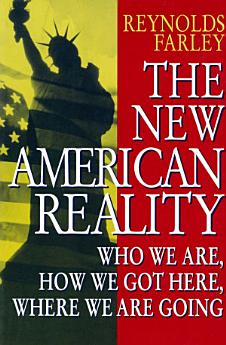
The New American Reality: Who We Are, How We Got Here, Where We Are Going
Aug 1996 · Russell Sage Foundation
Ebook
396
Pages
About this ebook
"A fascinating and authoritative account of American social history since 1960 as viewed through the prism of government statistics....[Farley] uses publicly available data, straight forward methods, and modest...language, to provide more information and insight about recent social trends than any other volume in print." —American Journal of Sociology "A brilliant piece of work. Farley is absolutely masterful at taking tens of thousands of national survey statistics and weaving from them a fascinating and beautifully illustrated tapestry of who we are." —Barry Bluestone, Frank L. Boyden Professor of Political Economy, University of Massachusetts, Boston The New American Reality presents a compelling portrait of an America strikingly different from what it was just forty years ago.Gone is the idealized vision of a two-parent, father-supported Ozzie and Harriet society. In its place is an America of varied races andethnic backgrounds, where families take on many forms and mothers frequently work outside the home. Drawing on a definitive analysis of the past four U.S. censuses, author Reynolds Farley reveals a country that offers new opportunities for a broader spectrum of people, while at the same time generating frustration and apprehension for many who once thought their futures secure. The trends that have so transformed the nation were kindled in the 1960s, a watershed period during which many Americans redefined their attitudes toward the rights of women and blacks. The New American Reality describes the activism, federal policymaking, and legal victories that eliminated overtracial and sexual discrimination. But along with open doors came new challenges. Divorce and out-of-wedlock births grew commonplace, forcing more women to raise children alone and—despite improved wages—increasing their chances of falling into poverty. Residential segregation, inadequate schooling, and a particularly high ratio of female-headed families severely impaired the economic progress of African Americans, many of whom were left behind in declining central cities as businesses migrated to suburbs. A new generation of immigrants from many nations joined the ranks of those working to support families and improve their prospects, and rapidly transformed the nation's ethnic composition. In the 1970s, unprecedented economic restructuring on a global scale created unexpected setbacks for the middle class. The long era of postwar prosperity ended as the nation's dominant industry shifted from manufacturing to services, competition from foreign producers increased, interest rates rose, and a new emphasis on technology and cost-cutting created a demand for more sophisticated skills in the workplace. The economic recovery of the 1980s generated greater prosperity for the well-educated and highly skilled, and created many low paying jobs, but offered little to remedy the stagnant and declining wages of the middle class. Income inequalitybecame a defining feature in the economic life of America: overall, the rich got richer while the poor and middle class found it increasingly difficult to meet their financial demands. The New American Reality reports some good news about America. Our lives are longer and healthier, the elderly are much better off than ever before, consumer spending power has increased, and minorities and women have many more opportunities. But this book does not shy away from the significant problems facing large portions of the population, and provides a valuable perspective on efforts to remedy them. The New American Reality offers the information necessary to understandthe critical trends affecting America today, from how we earn a living to how and when we form families, where we live, and whether or not we will continue to prosper. A Volume in the Russell Sage Founadtion Census Series
"A fascinating and authoritative account of American social history since 1960 as viewed through the prism of government statistics....[Farley] uses publicly available data, straight forward methods, and modest...language, to provide more information and insight about recent social trends than an...
About the author
REYNOLDS FARLEY is professor of sociology at the University of Michigan and research scientist at its Population Studies Center.
REYNOLDS FARLEY is professor of sociology at the University of Michigan and research scientist at its Population Studies Center.
Rate this ebook
Tell us what you think.
Reading information
Smartphones and tablets
Install the Google Play Books app for Android and iPad/iPhone. It syncs automatically with your account and allows you to read online or offline wherever you are.
Laptops and computers
You can listen to audiobooks purchased on Google Play using your computer's web browser.
eReaders and other devices
To read on e-ink devices like Kobo eReaders, you'll need to download a file and transfer it to your device. Follow the detailed Help Center instructions to transfer the files to supported eReaders.