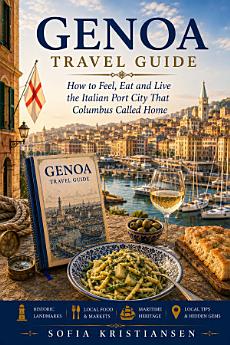
GENOA TRAVEL GUIDE: How to Feel, Eat and Live the Italian Port City That Columbus Called Home
Sofía Kristiansen
Ebook
24
Pages
Tools
info
family_home
Eligible
info
About this ebook
Genoa is not an easy city to love at first sight — and that is precisely the reason to give it more than one. La Superba, the proud one, as Petrarch called it, was once one of the most powerful cities in the world: its merchants financed the Spanish empire, its navigators charted the Black Sea, and its most famous son sailed west for Spain in 1492 and changed the map of the world. The physical legacy of this greatness is the largest medieval city center in Italy, a UNESCO-designated street of Renaissance palaces containing the finest concentration of Van Dyck and Rubens outside their home countries, and a food culture of fierce regional pride built on pesto made in a marble mortar, focaccia soaked in Ligurian olive oil, and farinata eaten hot from the wood-fired oven.
In this complete travel guide, Sofía Kristiansen takes you through every layer of the city: the caruggi and their medieval density, the Via Garibaldi palaces and their extraordinary art collections, the Porto Antico and the maritime heritage, the Ligurian Riviera and the Cinque Terre, and the specific Genoese character — direct, proud, indifferent to being liked — that makes this one of the most genuinely Italian cities left in Italy. Genoa has been one of the great cities. This guide helps you understand why.
Genoa is not an easy city to love at first sight — and that is precisely the reason to give it more than one. La Superba, the proud one, as Petrarch called it, was once one of the most powerful cities in the world: its merchants financed the Spanish empire, its navigators charted the Black Sea, a...
Discover more
Rate this ebook
Tell us what you think.
Reading information
Smartphones and tablets
Install the Google Play Books app for Android and iPad/iPhone. It syncs automatically with your account and allows you to read online or offline wherever you are.
Laptops and computers
You can listen to audiobooks purchased on Google Play using your computer's web browser.
eReaders and other devices
To read on e-ink devices like Kobo eReaders, you'll need to download a file and transfer it to your device. Follow the detailed Help Center instructions to transfer the files to supported eReaders.