About this ebook
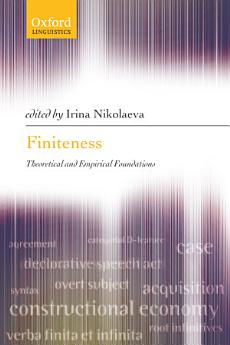
This book explores the nature of finiteness, one of most commonly used notions in descriptive and theoretical linguistics but possibly one of the least understood. Scholars representing a variety of theoretical positions seek to clarify what it is and to establish its usefulness and limitations. In doing so they reveal cross-linguistically valid correlations between subject licensing, subject agreement, tense, syntactic opacity, and independent clausehood; show how these properties are associated with finiteness; and discuss what this means for the content of the category. The issues explored include how different grammatical theories represent finiteness; whether the finite/nonfinite distinction is universal; whether there are degrees of finiteness; whether the syntactic notion of finiteness has a semantic corollary; whether and how finiteness is subject to change; and how finiteness features in language acquisition. Irina Nikolaeva opens the book by describing the history of finiteness and its place in current thinking and research. She then introduces the chapters of the book, comparing the authors' perspectives and showing what they have in common. The book is then divided into four parts. Part I considers the role finiteness plays in formal syntactic theories and Part II its deployment in functional theories and as the subject of research in typology. Parts III and IV look respectively at the finite/nonfinite opposition in individual languages and at the role finiteness plays in linguistic change and linguistic development. The book is written and structured to appeal to scholars and students of syntax and general linguistics at graduate level and above.
This book explores the nature of finiteness, one of most commonly used notions in descriptive and theoretical linguistics but possibly one of the least understood. Scholars representing a variety of theoretical positions seek to clarify what it is and to establish its usefulness and limitations. ...
About the author
Irina Nikolaeva is a Research Associate in Linguistics at the University of Oxford. She has a PhD in Linguistics from the University of Leiden. Her interests include syntax, morphology, typology, lexicalist theories of grammar, and the documentation of endangered languages. She has published books on Uralic, Altaic, and Palaeosiberian languages, as well as papers on the syntax-semantics and syntax-information structure interface, phonology, and historical-comparative linguistics.
Irina Nikolaeva is a Research Associate in Linguistics at the University of Oxford. She has a PhD in Linguistics from the University of Leiden. Her interests include syntax, morphology, typology, lexicalist theories of grammar, and the documentation of endangered languages. She has published book...
Rate this ebook
Tell us what you think.
Reading information
Smartphones and tablets
Install the Google Play Books app for Android and iPad/iPhone. It syncs automatically with your account and allows you to read online or offline wherever you are.
Laptops and computers
You can listen to audiobooks purchased on Google Play using your computer's web browser.
eReaders and other devices
To read on e-ink devices like Kobo eReaders, you'll need to download a file and transfer it to your device. Follow the detailed Help Center instructions to transfer the files to supported eReaders.


