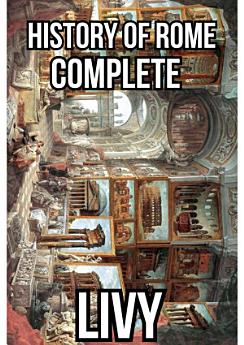
History of Rome
Titus Livius
May 2017 · Half Past history
Ebook
1779
Pages
family_home
Eligible
info
About this ebook
An epic endeavor by a man genuinely enamored of his native Rome, Livy's The History of Rome was originally written in 142 books spanning the entire history of the Roman people up to Livy's day in the time of Augustus in the first century BC. While this Roman historian's monumental undertaking took most of his life, only 35 books still survive today. Livy begins with Aeneas' landing on Italy and the myth of Romulus and Remus' founding of Rome. He also thoroughly covers numerous wars, such as the Samnite Wars, the Punic Wars, and the Social War, as well as all of the rulers of Rome, including Julius Caesar, Nero, and Augustus. Though the work is a bit biased, its countless references to other sources are a testament of Livy's attempt to create an accurate, understandable history of the Roman Kingdom, and, later, the Republic. Simultaneously a glorification of Rome and a passionate warning to future Romans, Ab Urbe Condita reflects the magnificence and ignominy, the opinions and interests, and the myths and political realities of one of history's most remarkable civilizations.
An epic endeavor by a man genuinely enamored of his native Rome, Livy's The History of Rome was originally written in 142 books spanning the entire history of the Roman people up to Livy's day in the time of Augustus in the first century BC. While this Roman historian's monumental undertaking too...
Discover more
About the author
Very little is known about the life of Livy (Titus Livius) other than that he was born in Patavium (modern-day Padua) and lived most of his life in Rome. It is clear from his writings that he was familiar with ancient Greek and Latin literature and was, in fact, influenced by Cicero. Although Livy produced several works on philosophy and literary criticism, his masterpiece and life work of 40 years was his "History of Rome", which covers a vast sweep of Rome's history from its origins to Livy's own time. Of the original 142 books that made up the work, only 35 are extant---Books 1--10 and 20--45---which treat the years 753--293 b.c. and 218--167 b.c. Fragments of others, however, do remain, and summaries exist of all but one. When he wrote the history, Livy, who extolled the virtues of discipline, piety, and patriotism, believed that Rome was in a state of decline and moral decay. Wealth and luxury, he wrote, had led to "the dark dawning of our modern day, when we can neither endure our vices nor face the remedies needed to cure them." According to modern standards, Livy was neither an impressive nor critical historian. He perpetuated many inaccuracies. This, however, does not greatly minimize the value of his writing. His acumen lay in his vibrant style, his keen eye for character, and his gift for dramatic composition.
Very little is known about the life of Livy (Titus Livius) other than that he was born in Patavium (modern-day Padua) and lived most of his life in Rome. It is clear from his writings that he was familiar with ancient Greek and Latin literature and was, in fact, influenced by Cicero. Although Liv...
Rate this ebook
Tell us what you think.
Reading information
Smartphones and tablets
Install the Google Play Books app for Android and iPad/iPhone. It syncs automatically with your account and allows you to read online or offline wherever you are.
Laptops and computers
You can listen to audiobooks purchased on Google Play using your computer's web browser.
eReaders and other devices
To read on e-ink devices like Kobo eReaders, you'll need to download a file and transfer it to your device. Follow the detailed Help Center instructions to transfer the files to supported eReaders.


