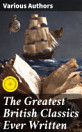
The Greatest British Classics (Annotated): Enriched Edition. Sons and Lovers, Wuthering Heights, Alice in Wonderland, Heart of Darkness, Ulysses, Hamlet...
Lewis Carroll · Charles Dickens · Oscar Wilde · Robert Louis Stevenson · William Shakespeare · George MacDonald · Bram Stoker · Charlotte Brontë · Emily Brontë · George Grossmith · Weedon Grossmith · Arthur Conan Doyle · Frances Hodgson Burnett · Joseph Conrad · Jane Austen · George Eliot · Laurence Sterne · Thomas Hardy · Jonathan Swift · Daniel Defoe · Henry Fielding · Kenneth Grahame · Wilkie Collins · William Makepeace Thackeray · John Milton · John Keats · James Joyce · Ann Ward Radcliffe · H. G. Wells · W. B. Yeats · J. M. Barrie · G. K. Chesterton · T. S. Eliot · D. H. Lawrence · E. M. Forster · Sir Walter Scott · George Bernard Shaw · Mary Shelley · P. B. Shelley · Elizabeth von Arnim
Dec 2023 · DigiCat
Ebook
14033
Pages
family_home
Eligible
info
About this ebook
The Greatest British Classics surveys the extraordinary formal and imaginative range of the British canon, bringing together romance, satire, realism, Gothic fiction, children's fantasy, detective narrative, adventure, drama, lyric poetry, and modernist experiment. Across its pages, courtly and comic traditions meet haunted houses, social panoramas, speculative futures, and psychologically charged interior worlds. The collection's significance lies in its capacity to place foundational works of English-language literature in productive proximity, revealing recurring concerns with class, empire, gender, morality, imagination, and national identity. Its contributors span several centuries and include novelists, playwrights, poets, essayists, and popular storytellers whose careers shaped Romanticism, Victorian realism, the Gothic revival, Aestheticism, Edwardian fantasy, and literary modernism. These voices emerge from differing social positions and historical moments—from the eighteenth-century rise of the novel through industrial modernity and imperial crisis—yet collectively demonstrate how British literature repeatedly revised its inherited forms. Their juxtaposition illuminates both continuity and contestation within the tradition. Ideal for students, general readers, and established admirers alike, this volume offers an unusually rich route through major literary movements and genres. It invites readers to compare styles, ethical questions, and narrative experiments within one capacious anthology, fostering a sustained dialogue between canonical works and the changing worlds that produced them. This enriched edition has been carefully crafted to add value to your reading experience. - An Introduction draws the threads together, discussing why these diverse authors and texts belong in one collection. - Historical Context explores the cultural and intellectual currents that shaped these works, offering insight into the shared (or contrasting) eras that influenced each writer. - A combined Synopsis (Selection) briefly outlines the key plots or arguments of the included pieces, helping readers grasp the anthology's overall scope without giving away essential twists. - A collective Analysis highlights common themes, stylistic variations, and significant crossovers in tone and technique, tying together writers from different backgrounds. - Reflection questions encourage readers to compare the different voices and perspectives within the collection, fostering a richer understanding of the overarching conversation.
The Greatest British Classics surveys the extraordinary formal and imaginative range of the British canon, bringing together romance, satire, realism, Gothic fiction, children's fantasy, detective narrative, adventure, drama, lyric poetry, and modernist experiment. Across its pages, courtly and c...
Discover more
About the author
Charles Lutwidge Dodgson, known by his pen name Lewis Carroll, was a prodigious figure in the realm of children's literature, mathematics, and logic (Carroll, 1865; Dodgson, 1896). He was born on January 27, 1832, in Daresbury, Cheshire, England, and passed away on January 14, 1898. Carroll's illustrious literary career is highlighted by his iconic works, 'Alice's Adventures in Wonderland' (1865) and its sequel 'Through the Looking-Glass' (1871), which continue to resonate with both children and adults for their whimsical narrative, ingenious wordplay, and fantastical characters. While 'The Greatest British Classics' may not be directly attributed to Carroll as an original work, it comprises, amongst various esteemed authors, the enduring legacy of his storytelling (Cohen, 1995). Carroll's literary style is characterized by a blend of nonsensical humor, poetry, and clever puzzles, often reflecting his mathematical background and penchant for logic. His works unabashedly explore the boundaries of imagination, challenging the rigid Victorian norms of his time (Kelly, 1990). Beyond literature, Carroll's contributions to mathematics, especially in the fields of linear algebra and symbolic logic, have been noteworthy (Wilson, 2008). His ecclesiastical upbringing and conservative view on social issues add depth to his profile as a versatile and complex figure of the 19th century. Carroll's influence extends into various aspects of popular culture, reflecting his status as a seminal author in the British literary canon.
Charles Lutwidge Dodgson, known by his pen name Lewis Carroll, was a prodigious figure in the realm of children's literature, mathematics, and logic (Carroll, 1865; Dodgson, 1896). He was born on January 27, 1832, in Daresbury, Cheshire, England, and passed away on January 14, 1898. Carroll's ill...
Rate this ebook
Tell us what you think.
Reading information
Smartphones and tablets
Install the Google Play Books app for Android and iPad/iPhone. It syncs automatically with your account and allows you to read online or offline wherever you are.
Laptops and computers
You can listen to audiobooks purchased on Google Play using your computer's web browser.
eReaders and other devices
To read on e-ink devices like Kobo eReaders, you'll need to download a file and transfer it to your device. Follow the detailed Help Center instructions to transfer the files to supported eReaders.