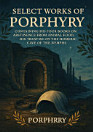
Select Works Of Porphyry: Restored Classics to Go Edition

· Otbebookpublishing
Ebook
395
Pages
Eligible

About this ebook

This volume gathers a scholarly translation of Porphyry, the great Neoplatonic philosopher and disciple of Plotinus, whose work helped preserve and revive Platonic thought. It centers on his defense of abstaining from animal food, his allegorical reading of Homer's Cave of the Nymphs, and his treatise on the means of perceiving intelligible reality, with an appendix exploring Ulysses' wanderings as a spiritual journey through the world of becoming. Together, these writings present philosophy as a path of purification, self-discipline, and ascent toward the One beyond intellect and being. The translation is accompanied by learned commentary that traces Porphyry's ethical sayings to earlier Pythagorean sources, correcting Greek readings and clarifying the lineage of his thought. It shows how his maxims on wisdom, piety, philanthropy, and freedom from passion are rooted in older traditions, while reinforcing a central claim: true devotion to God cannot coexist with greed, pleasure, or bodily excess. At the heart of the collection is a forceful defense of vegetarianism as moral and intellectual discipline. Porphyry answers Stoic, Peripatetic, and Epicurean objections, argues that justice extends to all living creatures, and presents abstinence from cruelty and flesh-eating as a way of becoming more godlike. This edition has been fully restored with modern typesetting, custom cover design.
This volume gathers a scholarly translation of Porphyry, the great Neoplatonic philosopher and disciple of Plotinus, whose work helped preserve and revive Platonic thought. It centers on his defense of abstaining from animal food, his allegorical reading of Homer's Cave of the Nymphs, and his tre...

About the author

Porphyry was a Greek philosopher, scholar, and influential commentator of the late Roman world, born in Tyre and educated in the intellectual centers of the eastern Mediterranean before becoming one of the most important students of Plotinus. Living at a time when classical philosophy was being challenged by new religious traditions and changing political realities, he devoted his life to preserving, clarifying, and defending the philosophical heritage of antiquity. His writings range across logic, metaphysics, ethics, religion, and literary criticism, and he became especially important for his sharp analytical mind and his ability to make difficult ideas more accessible. He is best remembered for shaping Neoplatonism into a more systematic tradition and for his powerful arguments on behalf of philosophical discipline, intellectual self-mastery, and the soul's ascent toward the divine. His work also reflects a deep concern with the relationship between reason and belief, the proper use of language, and the moral responsibilities of the thinker. These themes remain strikingly relevant today, especially in an age still wrestling with questions of truth, interpretation, spirituality, and the place of philosophy in public life. Porphyry's legacy endures not only because he helped preserve ancient thought, but because he modeled a rigorous, searching way of reading the world. Readers who enjoy philosophical reflection, the history of ideas, and thoughtful engagement with the ancient mind will find him especially rewarding.


Porphyry was a Greek philosopher, scholar, and influential commentator of the late Roman world, born in Tyre and educated in the intellectual centers of the eastern Mediterranean before becoming one of the most important students of Plotinus. Living at a time when classical philosophy was being c...

Rate this ebook

Tell us what you think.

Reading information

Smartphones and tablets
Install the Google Play Books app for Android and iPad/iPhone. It syncs automatically with your account and allows you to read online or offline wherever you are.
Laptops and computers
You can listen to audiobooks purchased on Google Play using your computer's web browser.
eReaders and other devices
To read on e-ink devices like Kobo eReaders, you'll need to download a file and transfer it to your device. Follow the detailed Help Center instructions to transfer the files to supported eReaders.