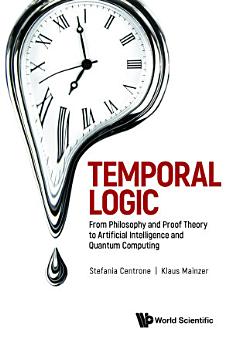
Temporal Logic: From Philosophy and Proof Theory to Artificial Intelligence and Quantum Computing
About this ebook
Computationally, temporal operators can be introduced in different formalisms with increasing complexity such as Basic Modal Logic (BML), Linear-Time Temporal Logic (LTL), Computation Tree Logic (CTL), and Full Computation Tree Logic (CTL*). Proof-theoretically, these formalisms of temporal logic can be interpreted by the sequent calculus of Gentzen, the tableau-based calculus, automata-based calculus, game-based calculus, and dialogue-based calculus with different advantages for different purposes, especially in computer science.
The book culminates in an outlook on trendsetting applications of temporal logics in future technologies such as artificial intelligence and quantum technology. However, it will not be sufficient, as in traditional temporal logic, to start from the everyday understanding of time. Since the 20th century, physics has fundamentally changed the modern understanding of time, which now also determines technology. In temporal logic, we are only just beginning to grasp these differences in proof theory which needs interdisciplinary cooperation of proof theory, computer science, physics, technology, and philosophy.