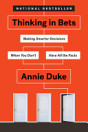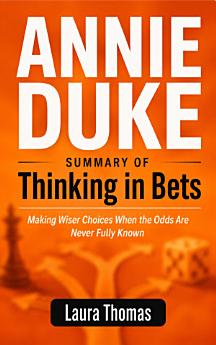
ANNIE DUKE ON Thinking in Bets: Making Wiser Choices When the Odds Are Never Fully Known
About this ebook
What if better decisions had less to do with being right—and more to do with thinking clearly when the outcome is uncertain?
Every day, we make choices without knowing exactly what will happen next. We judge opportunities, assess risks, interpret information, make financial and career decisions, and act on predictions that may or may not come true. The problem is that the human mind often treats uncertain outcomes as proof that a decision was either brilliant or foolish.
SUMMARY OF Thinking in Bets offers a practical introduction to smarter decision-making under uncertainty. It explores how to separate the quality of a decision from its outcome, recognize the role of probability and chance, challenge personal assumptions, reduce cognitive bias, and develop better judgment when the odds are never completely known.
If you want to improve your decision-making skills, think more critically, make better decisions, manage uncertainty, evaluate risk, and develop a more rational approach to everyday choices, this concise summary provides useful concepts to consider and apply.
Rather than promising certainty, this book encourages a more disciplined way to think: examine the information available, consider alternative possibilities, question your assumptions, and make the best decision you can with the evidence at hand.
Why read it? Because a good decision can still produce a bad result—and a poor decision can sometimes get lucky. Understanding that difference can change how you approach risk assessment, critical thinking, probability, uncertainty, judgment, and strategic decision-making.
Read this summary now and discover practical ideas for making wiser choices when the future cannot be known with certainty.
Disclaimer: This is an independent summary and educational companion inspired by the concepts discussed in Annie Duke’s Thinking in Bets. It is not affiliated with, sponsored by, endorsed by, or published by Annie Duke or the original publisher. It is not a substitute for the original book, which readers may wish to consult for the author’s complete arguments and examples.