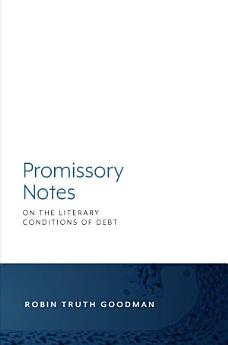
Promissory Notes: On the Literary Conditions of Debt
Jan 2018 · Lever Press
Ebook
90
Pages
Tools
info
family_home
Eligible
info
About this ebook
There is no doubt that the beginning of the twenty-first century was marked by crises of debt. Less well known is that literature played a historical role in defining and teaching debt to the public. Promissory Notes: On the Literary Conditions of Debt addresses how neoliberal finance has depended upon a historical linking of geopolitical inequality and financial representation that positions the so-called “Third World” as negative value, or debt. Starting with an analysis of Anthony Trollope’s novel, The Eustace Diamonds, Goodman shows how colonized spaces came to inhabit this negative value. Promissory Notes argues that the twentieth-century continues to apply literary innovations in character, subjectivity, temporal and spatial representation to construct debt as the negative creation of value not only in reference to objects, but also houses, credit cards, students, and, in particular, “Third World” geographies, often leading to crisis. Yet, late twentieth century and early twenty-first literary texts, such as Soyinka’s The Road and Ngugi’s Wizard of the Crow, address the negative space of the indebted world also as a critique of the financial take-over of the postcolonial developmental state. Looking to situations like the Puerto Rican debt crisis, Goodman demonstrates how financial discourse is articulated through social inequalities and how literature can both expose and contest the imposition of a morality of debt as a mode of anti-democratic control.
There is no doubt that the beginning of the twenty-first century was marked by crises of debt. Less well known is that literature played a historical role in defining and teaching debt to the public. Promissory Notes: On the Literary Conditions of Debt addresses how neoliberal finance has depende...
About the author
Robin Truth Goodman is a Professor of English at Florida State University. She is interested in how literature and critical theory help us understand and oppose the power of institutions and the social oppressions of the new economy. Besides her many authored and edited books, articles, and book chapters, Dr. Goodman received FSU’s Developing Scholar award in 2009 and was a Global Fellow at University of California, Los Angeles in 2003-2004. She has served as the Director of the Literature Program from 2011-2014 and again from 2016-2018.
Robin Truth Goodman is a Professor of English at Florida State University. She is interested in how literature and critical theory help us understand and oppose the power of institutions and the social oppressions of the new economy. Besides her many authored and edited books, articles, and book ...
Rate this ebook
Tell us what you think.
Reading information
Smartphones and tablets
Install the Google Play Books app for Android and iPad/iPhone. It syncs automatically with your account and allows you to read online or offline wherever you are.
Laptops and computers
You can listen to audiobooks purchased on Google Play using your computer's web browser.
eReaders and other devices
To read on e-ink devices like Kobo eReaders, you'll need to download a file and transfer it to your device. Follow the detailed Help Center instructions to transfer the files to supported eReaders.