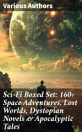
The Greatest Sci-Fi Classics: The War of The Worlds, Anthem, Frankenstein, The Lost World, Iron Heel, Dr Jekyll and Mr Hyde...
Jules Verne · Mark Twain · Robert Louis Stevenson · Edgar Allan Poe · William Hope Hodgson · George MacDonald · Jack London · Arthur Conan Doyle · Ayn Rand · David Lindsay · Edward Bellamy · Charlotte Perkins Gilman · Abraham Merritt · H. G. Wells · H. Rider Haggard · Mary Shelley · Edward Bulwer-Lytton · Edwin A. Abbott · Hugh Benson
Dec 2023 · DigiCat
Ebook
4354
Pages
family_home
Eligible
info
About this ebook
The anthology 'The Greatest Sci-Fi Classics' meticulously curates seminal works that have shaped and expanded the boundaries of science fiction. Encompassing a rich tapestry of narrative forms— from gothic horror infused journeys to thought-provoking extrapolations of technology and society—this collection captures the genre's evolution from the 19th to early 20th centuries. These works explore worlds where reason meets imagination, traversing dreamlike realms and the intricate workings of advanced societies. Intriguing tales like outlandish adventures and speculative what-ifs engage readers in timeless inquiries about human nature and the universe, resonating with enduring significance. The authors, ranging from visionary forerunners such as Mary Shelley to radical thinkers like H.G. Wells and Ayn Rand, each bear a distinctive voice that contributes to the genre's diversified dialogue. The collection aligns itself with cultural and literary movements such as Romanticism and the Industrial Revolution, reflecting a century rife with scientific curiosity and existential contemplation. The anthology underscores how diverse narrative perspectives—from Jules Verne's meticulous adventure to Edgar Allan Poe's psychological forays—enrich the genre's panoramic view. Inviting readers into a literary odyssey, 'The Greatest Sci-Fi Classics' offers a unique chance to engage with masterful storytelling across varied thematic landscapes. This anthology is a treasure trove for literary scholars and casual readers alike, providing educational value and a wealth of insights on the human condition. By immersing oneself in this collection, the reader embraces a dialogue across time and space, where each story unlocks new dimensions of thought and imagination, making this anthology an indispensable addition to any literary collection.
The anthology 'The Greatest Sci-Fi Classics' meticulously curates seminal works that have shaped and expanded the boundaries of science fiction. Encompassing a rich tapestry of narrative forms— from gothic horror infused journeys to thought-provoking extrapolations of technology and society—this ...
Discover more
About the author
Jules Verne (1828-1905), a French novelist, poet, and playwright, is best known for his adventure novels and his profound influence on the literary genre of science fiction. Born in the seaport of Nantes, Verne's early exposure to the open sea would stir his imagination for travel and adventure. While initially steered toward a career in law to fulfill familial expectations, Verne's passion for writing prevailed. With works such as 'Journey to the Center of the Earth' (1864), 'From the Earth to the Moon' (1865), 'Twenty Thousand Leagues Under the Sea' (1870), and 'Around the World in Eighty Days' (1873), Verne has woven narratives rich in scientific curiosity and exploration. His 'Voyages Extraordinaires' series of novels embody his unique literary style—meticulously researched journeys set within the framework of the natural world and technological innovation. Often referred to as the 'Father of Science Fiction', Verne's speculative storytelling preempted many technological advances of the 20th century, demonstrating a visionary quality matched by his captivating prose. A master of integrating education with entertainment, Verne's work continues to inspire a sense of wonder and the pursuit of knowledge. 'The Greatest Sci-Fi Classics' underscores the breadth and significance of Verne's contributions to literature and science fiction, enchanting readers decades beyond his passing.
Jules Verne (1828-1905), a French novelist, poet, and playwright, is best known for his adventure novels and his profound influence on the literary genre of science fiction. Born in the seaport of Nantes, Verne's early exposure to the open sea would stir his imagination for travel and adventure. ...
Rate this ebook
Tell us what you think.
Reading information
Smartphones and tablets
Install the Google Play Books app for Android and iPad/iPhone. It syncs automatically with your account and allows you to read online or offline wherever you are.
Laptops and computers
You can listen to audiobooks purchased on Google Play using your computer's web browser.
eReaders and other devices
To read on e-ink devices like Kobo eReaders, you'll need to download a file and transfer it to your device. Follow the detailed Help Center instructions to transfer the files to supported eReaders.