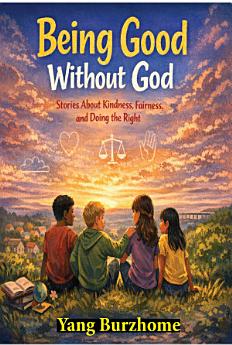
Being Good Without God: A Secular Guide to Kindness, Fairness, and Moral Courage for Kids and Teens
About this ebook
Being Good Without God is a warm, story-driven exploration of kindness, fairness, empathy, and moral courage — written especially for secular families, curious young readers, and thoughtful teens asking big questions.
Through engaging stories, age-accessible explanations, and thoughtful discussion prompts, this book explores:
Why helping others feels right
Where moral ideas come from
Why the world can be unfair
How societies develop shared norms
Why good people disagree
When rules should be questioned
How to act ethically even when no one is watching
Blending storytelling with insights from psychology, evolution, and social science, this book introduces young readers to moral reasoning without preaching, fear, or dogma.
It does not criticize religion.
It simply asks:
If goodness is human-made, how can we build it wisely?
Perfect for:
Atheist and secular parents
Humanist families
Educators teaching ethical literacy
Teens exploring morality outside religion
Families who value curiosity, dialogue, and critical thinking
With reflection exercises, “What Would You Do?” scenarios, and deeper-dive sidebars for teens and adults, this book grows with the reader — making it ideal for family discussion or classroom use.
Morality is not a finished rulebook.
It is an ongoing human project.
And this book invites young minds to take part.Can children learn to be good without being told that goodness comes from above?
Being Good Without God is a warm, story-driven exploration of kindness, fairness, empathy, and moral courage — written especially for secular families, curious young readers, and thoughtful teens asking big questions.
Through engaging stories, age-accessible explanations, and thoughtful discussion prompts, this book explores:
Why helping others feels right
Where moral ideas come from
Why the world can be unfair
How societies develop shared norms
Why good people disagree
When rules should be questioned
How to act ethically even when no one is watching
Blending storytelling with insights from psychology, evolution, and social science, this book introduces young readers to moral reasoning without preaching, fear, or dogma.
It does not criticize religion.
It simply asks:
If goodness is human-made, how can we build it wisely?
Perfect for:
Atheist and secular parents
Humanist families
Educators teaching ethical literacy
Teens exploring morality outside religion
Families who value curiosity, dialogue, and critical thinking
With reflection exercises, “What Would You Do?” scenarios, and deeper-dive sidebars for teens and adults, this book grows with the reader — making it ideal for family discussion or classroom use.
Morality is not a finished rulebook.
It is an ongoing human project.
And this book invites young minds to take part.
Discover more
About the author
Can children learn to be good without being told that goodness comes from above?
Being Good Without God is a warm, story-driven exploration of kindness, fairness, empathy, and moral courage — written especially for secular families, curious young readers, and thoughtful teens asking big questions.
Through engaging stories, age-accessible explanations, and thoughtful discussion prompts, this book explores:
Why helping others feels right
Where moral ideas come from
Why the world can be unfair
How societies develop shared norms
Why good people disagree
When rules should be questioned
How to act ethically even when no one is watching
Blending storytelling with insights from psychology, evolution, and social science, this book introduces young readers to moral reasoning without preaching, fear, or dogma.
It does not criticize religion.
It simply asks:
If goodness is human-made, how can we build it wisely?
Perfect for:
Atheist and secular parents
Humanist families
Educators teaching ethical literacy
Teens exploring morality outside religion
Families who value curiosity, dialogue, and critical thinking
With reflection exercises, “What Would You Do?” scenarios, and deeper-dive sidebars for teens and adults, this book grows with the reader — making it ideal for family discussion or classroom use.
Morality is not a finished rulebook.
It is an ongoing human project.
And this book invites young minds to take part.