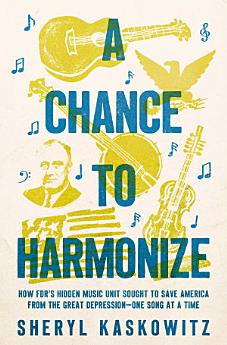
A Chance to Harmonize: How FDR's Hidden Music Unit Sought to Save America from the Great Depression—One Song at a Time
Apr 2024 · Sold by Simon and Schuster
Ebook
352
Pages
family_home
Eligible
info
About this ebook
The remarkable story of a hidden New Deal program that tried to change America and end the Great Depression using folk music, laying the groundwork for the folk revival and having a lasting impact on American culture.
In 1934, the Great Depression had destroyed the US economy, leaving residents poverty-stricken. First Lady Eleanor Roosevelt urged President Roosevelt to take radical action to help those hit hardest—Appalachian miners and mill workers stranded after factories closed, city dwellers with no hope of getting work, farmers whose land had failed. They set up government homesteads in rural areas across the country, an experiment in cooperative living where people could start over. To boost morale and encourage the homesteaders to find community in their own traditions, the administration brought in artists to lead group activities—including folk music.
As part of a music unit led by Charles Seeger (father of Pete), staffer Sidney Robertson traveled the country to record hundreds of folk songs. Music leaders, most notably Margaret Valiant, were sent to homesteads to use the collected songs to foster community and cooperation. Working almost entirely (and purposely) under the radar, the music unit would collect more than 800 songs and operate for nearly two years, until they were shut down under fire from a conservative coalition in Congress that deemed the entire homestead enterprise dangerously “socialistic."
Despite its early demise, the music unit proved that music can provide hope and a sense of belonging even in the darkest times. It also laid the groundwork for the folk revival that followed, seeing the rise of artists like Woody Guthrie, Pete Seeger, Odetta, and Bob Dylan.
Award-winning author and Harvard-trained American music scholar Sheryl Kaskowitz has had the unique opportunity to listen to the music unit’s entire collection of recordings and examine a trove of archival materials, some of which have never been made available to the public.
A Chance To Harmonize reveals this untold story and will delight readers with the revelation of a new and previously undiscovered chapter in American cultural history.
The remarkable story of a hidden New Deal program that tried to change America and end the Great Depression using folk music, laying the groundwork for the folk revival and having a lasting impact on American culture.
In 1934, the Great Depression had destroyed the US economy, leaving residents ...
Discover more
About the author
Sheryl Kaskowitz, PhD, is the author of God Bless America: The Surprising History of an Iconic Song, which won an ASCAP Deems Taylor Book Award for music writing. Her articles have been published in the New York Times, Slate, Bloomberg News, and other outlets. Kaskowitz earned her PhD in music with an ethnomusicology focus from Harvard in 2011 and completed her BA in music at Oberlin. She has served as a lecturer at Brandeis University and Brown University and lives with her family in Berkeley, California.
Sheryl Kaskowitz, PhD, is the author of God Bless America: The Surprising History of an Iconic Song, which won an ASCAP Deems Taylor Book Award for music writing. Her articles have been published in the New York Times, Slate, Bloomberg News, and other outlets. Kaskowitz earned her PhD in music wi...
Rate this ebook
Tell us what you think.
Reading information
Smartphones and tablets
Install the Google Play Books app for Android and iPad/iPhone. It syncs automatically with your account and allows you to read online or offline wherever you are.
Laptops and computers
You can listen to audiobooks purchased on Google Play using your computer's web browser.
eReaders and other devices
To read on e-ink devices like Kobo eReaders, you'll need to download a file and transfer it to your device. Follow the detailed Help Center instructions to transfer the files to supported eReaders.