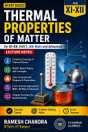
About this ebook
By Ramesh Chandra (B.Tech, IIT Kanpur)
Mechanical Properties of Solids is a comprehensive guide designed for Class XI-XII students, NEET aspirants, and JEE Main & JEE Advanced candidates seeking a strong conceptual understanding of elasticity and the mechanical behaviour of materials.
Based on the NCERT curriculum and aligned with the requirements of competitive examinations, this book presents the chapter in a structured and accessible manner. Concepts are developed from first principles and connected to problem-solving techniques commonly used in board examinations and entrance tests.
Written by Ramesh Chandra (B.Tech, IIT Kanpur), the book emphasizes conceptual clarity, analytical thinking, and systematic application of physics principles. Each topic is explained with detailed theory, illustrations, solved examples, and practice questions to help students strengthen both understanding and problem-solving skills.
The book covers all major topics, including stress and strain, stress-strain curves, Young's modulus, shear modulus, bulk modulus, compressibility, Poisson's ratio, elastic potential energy, energy density, thermal stress, torsion, rod as a spring, elongation under self-weight, rotating rods, and applications of elasticity.
Key Features
• Complete coverage of Mechanical Properties of Solids based on NCERT
• Suitable for Class XI-XII Physics, NEET, JEE Main, and JEE Advanced
• Clear explanations supported by diagrams and worked examples
• Important formulas, derivations, and conceptual summaries
• Smart Revision Notes for efficient exam preparation
• Previous Years' Questions (PYQs) from NEET, JEE Main, and JEE Advanced
• Practice problems ranging from basic to advanced difficulty levels
• Focus on conceptual understanding and application-based learning
Topics Covered
Stress and Strain
Longitudinal, Bulk, and Shear Stress
Stress-Strain Curve
Elastic Moduli
Young's Modulus
Shear Modulus (Modulus of Rigidity)
Bulk Modulus
Compressibility
Bulk Modulus of Gases
Poisson's Ratio
Elastic Potential Energy
Energy Density
Rod as a Spring
Elongation of Rod Under Self Weight
Elongation of Rotating Rod
Thermal Stress
Torsion
Applications of Elastic Behaviour of Materials
NEET, JEE Main, and JEE Advanced Previous Years' Questions
This book serves as a focused resource for students aiming to build a solid foundation in Mechanics while preparing for board examinations and competitive entrance tests. By combining theory, applications, and examination-oriented practice, it supports both learning and revision throughout the academic year.
Keywords: Mechanical Properties of Solids, Class 11 Physics, NCERT Physics, NEET Physics, JEE Main Physics, JEE Advanced Physics, Elasticity, Stress and Strain, Young's Modulus, Shear Modulus, Bulk Modulus, Poisson's Ratio, Thermal Stress, Torsion, Physics PYQs, Competitive Exam Physics.
Discover more
Ratings and reviews

- Flag inappropriate
About the author
Ramesh Chandra is a Physics educator and an alumnus of IIT Kanpur, where he earned his B.Tech degree. He has several years of experience mentoring students preparing for JEE Main, JEE Advanced, NEET, Olympiads, and school-level examinations.
Known for his concept-driven teaching style, Mr. Chandra specializes in simplifying challenging Physics topics through logical explanations, visual reasoning, and systematic problem-solving approaches. His teaching methodology focuses on building strong fundamentals while developing the analytical skills required for competitive examinations.
Over the years, he has designed study materials, revision notes, and problem sets covering a wide range of Physics topics for students and educators. His resources emphasize conceptual clarity, application-based learning, and effective revision strategies aligned with NCERT and competitive examination requirements.
In Mechanical Properties of Solids, Mr. Chandra combines classroom experience with examination insights to present a structured treatment of elasticity, stress and strain, elastic moduli, thermal stress, torsion, and related applications. The book is designed to help students develop a clear understanding of the subject while strengthening their problem-solving abilities for board examinations and entrance tests.
His academic resources are intended to bridge the gap between foundational learning and advanced problem solving, making Physics more accessible, intuitive, and engaging for learners at different levels.