DAPPLEGRIM - A Norwegian Fairy Tale: Baba Indaba Children?s Stories - Issue 177
About this ebook
ISSN: 2397-9607 Issue 177
ÿ
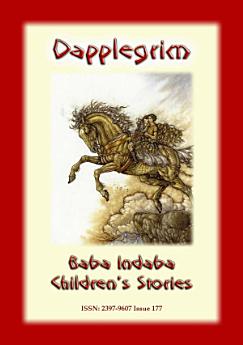
In this 177th issue of the Baba Indaba?s Children's Stories series, Baba Indaba narrates the story of Dapplegrim, the world?s largest horse. The youngest of 12 brothers leaves home to seek his fortune. When he returns, he finds his parents have passed on and his brothers, not knowing if he was alive, have divided the estate between them leaving him nothing but 12 mares on a high mountain paddock. He accepts this as his inheritance and in the first year one mare has a foal which tells him to kill all the other foals born that year which will allow him to suckle all the milk from the 12 mares so that he may grow large. This he does. When he returns the next year, the horse is the largest he has ever seen. But the foal tells him to kill the new brood of foals so that he may grow even larger. He does this again and when he returns the horse is so large it has to kneel to allow the youth to mount him. The youth hears that the king?s daughter has been kidnapped and the king is offering her hand in marriage and half the kingdom. He rides to the palace and presents himself to the king, who is very impressed at the size of Dapplegrim and agrees to youth undertaking a quest to find her.
............??. Download and read this story and find out if the youth did indeed rescue the princess and if the King kept his word and allowed the youth to marry her. Also, was the king really prepared to share his kingdom, or was he too greedy?.?
ÿ
INCLUDES LINKS TO DOWNLOAD 8 FREE STORIES
ÿ
Each issue also has a "WHERE IN THE WORLD - LOOK IT UP" section, where young readers are challenged to look up a place on a map somewhere in the world. The place, town or city is relevant to the story.
HINT - use Google maps.
ÿ
Baba Indaba is a fictitious Zulu storyteller who narrates children's stories from around the world. Baba Indaba translates as "Father of Stories".
ÿ
It is believed that folklore and tales are believed to have originated in India and made their way overland along the Silk and Spice routes and through the Middle East and Central Asia before arriving in Europe. Even so, this does not cover all folklore from all four corners of the world. Indeed folklore, legends and myths from Africa, Australia, Polynesia, and some from Asia too, can be altogether quite different and seem to have originated on the whole from separate reservoirs of lore, legend and culture.
Discover more
About the author
The Baba Indaba Children's Stories, published by Abela Publishing, often uses folklore and fairy tales which have their origins mists of time. Afterall who knows who wrote the story of Cinderella, also known in other cultures as Tattercoats or Conkiajgharuna. So who wrote the original? The answer is simple. No-one knows, or will ever know, so to assume that anyone owns the rights to these stories is nothing but nonsense. As such, we have decided to use the Author name "Anon E. Mouse" which, of course, is a play on the word "Anonymous".