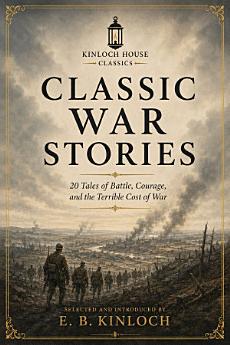
Classic War Stories: 20 Tales of Battle, Courage, and the Terrible Cost of War
About this ebook
The collection includes Thomas Hardy’s tales of invasion anxiety and military love; Balzac’s severe “El Verdugo”; Tolstoy’s clear-eyed accounts of the Caucasus and Sevastopol; Ambrose Bierce’s “An Occurrence at Owl Creek Bridge” and “Chickamauga”; Stephen Crane’s searching Civil War stories; Maupassant’s “Two Friends” and “Mother Sauvage”; Kipling and Arthur Conan Doyle on captivity, empire, and divided allegiance; H. G. Wells’s prophetic “The Land Ironclads”; and First World War fiction by Joseph Conrad and Edith Wharton.
Arranged chronologically by conflict, these twenty works move beyond battlefield spectacle to examine occupation, fear, duty, friendship, injury, memory, and moral uncertainty. They show how public violence enters private rooms—and how its consequences remain after armies have moved on.
Selected and introduced by E. B. Kinloch, this Kinloch House Classics edition includes an original introduction, afterword, acknowledgements, and concise editorial notes for every selection, while preserving the complete public-domain texts.
Discover more
About the author
E. B. Kinloch is the editor and curator of Kinloch House Classics, a small independent publishing house devoted to carefully selected editions of classic public-domain literature. Each collection preserves the original texts while presenting them in clear, readable editions for contemporary readers.
Kinloch House Classics specializes in themed anthologies spanning ghost stories, science fiction, mystery, folklore, adventure, and other enduring literary traditions.
Thomas Hardy was an English novelist, poet, and short-story writer whose work is strongly associated with Wessex, his imaginative version of south-west England. His major novels include Far from the Madding Crowd, The Return of the Native, The Mayor of Casterbridge, Tess of the d'Urbervilles, and Jude the Obscure. Hardy's fiction often examines desire, chance, class, rural change, and the pressure of social convention. Later in life he devoted himself increasingly to poetry. His tragic imagination, landscape writing, and structural control made him one of the major English writers of the nineteenth century.
Honoré de Balzac was a French novelist and playwright whose vast sequence of interconnected novels and stories, La Comédie Humaine, formed one of the monumental achievements of nineteenth-century realism. His best-known works include Père Goriot, Eugénie Grandet, Lost Illusions, and Cousin Bette. Balzac depicted French society across all social strata following the French Revolution and the Napoleonic era, combining meticulous physical description, financial and legal realism, obsessive character types, and profound dramatic momentum. His sweeping sociological vision and psychological depth exerted a foundational influence on the development of the European novel.
Joseph Conrad was a Polish-born novelist and short-story writer who became one of the major prose stylists in English literature. After years at sea in the French and British merchant services, he drew on maritime life, colonial trade, isolation, and moral uncertainty in works including Lord Jim, Nostromo, The Secret Agent, and Heart of Darkness. Conrad's fiction is known for its layered narration, psychological pressure, and sceptical treatment of power, ambition, and self-deception. His stories of river stations, ships, and distant settlements helped reshape modern fiction's sense of atmosphere and moral ambiguity.
Arthur Conan Doyle was a Scottish-born physician and writer best known as the creator of Sherlock Holmes and Dr Watson. Beginning with A Study in Scarlet, his four Holmes novels and fifty-six short stories established many of the conventions of modern detective fiction. Doyle also wrote historical adventures, supernatural fiction, the Professor Challenger novel The Lost World, and stories featuring the Napoleonic soldier Brigadier Gerard. His medical training informed his interest in observation and evidence, while his storytelling ranged far beyond crime. Holmes remains one of literature's most recognisable characters, and Doyle's influence on mystery and adventure writing is enduring.
Leo Tolstoy was a Russian novelist, essayist, moral philosopher, and short-story writer whose epic works stand among the highest achievements of world literature. His masterpiece novels War and Peace and Anna Karenina offer panoramic visions of Russian society, military history, family life, and psychological truth. Tolstoy drew upon his own military service in the Caucasus and the Crimean War for early masterpieces such as the Sevastopol Sketches and The Cossacks, later writing celebrated novellas including The Death of Ivan Ilyich and Hadji Murad. His unmatched realism, moral searching, and insight into human consciousness profoundly transformed the modern novel.
Ambrose Bierce was an American short-story writer, journalist, essayist, and satirist whose experiences as a Union soldier in the American Civil War deeply shaped his fiction. He is best known for terrifyingly precise war stories such as “An Occurrence at Owl Creek Bridge” and “Chickamauga,” collected in Tales of Soldiers and Civilians, as well as his cynical lexicon The Devil's Dictionary. Bierce's writing is celebrated for its mordant irony, compressed prose, psychological tension, and unflinching depiction of physical horror and the surreal illusions of the dying mind. His work remains a landmark in American realism and dark psychological fiction.
Stephen Crane was an American novelist, poet, journalist, and short-story writer whose direct, vivid prose helped carry American fiction toward literary realism and naturalism. He is best known for The Red Badge of Courage, a novel of war and fear, and for stories including “The Open Boat.” Crane also wrote closely about urban poverty and precarious work, drawing on observation as a journalist. His writing often places individuals under social, economic, or physical pressure and records their responses with unusual compression and intensity.
Harold Frederic was an American novelist, journalist, and short-story writer whose fiction brought realistic observation and psychological insight to regional and historical subjects. As a foreign correspondent for The New York Times, he lived much of his adult life in England while continuing to write about his native Mohawk Valley. His most famous novel, The Damnation of Theron Ware, is a classic study of religious doubt, provincial culture, and intellectual pride. Frederic also wrote notable Civil War fiction, including In the Sixties and the novella collection The Deserter and Other Stories, which explored the home front, the pressures of duty, and the human cost of conflict.
Guy de Maupassant was a French novelist and master of the short story whose prolific output established him as one of the defining figures of literary naturalism. Mentored by Gustave Flaubert, he drew on his service during the Franco-Prussian War and his keen observation of Parisian society and Norman provincial life in hundreds of tales, including “Boule de Suif,” “The Necklace,” and “Two Friends,” as well as novels such as Bel-Ami and Une Vie. Maupassant's fiction is renowned for its economy of style, objective detachment, ironic twists, and compassionate yet unsparing examination of human vulnerability, social hypocrisy, and the cruelties of war.
Rudyard Kipling was an English author, poet, and journalist best known for his vivid tales of empire, adventure, and distant places. Born in India in 1865, he drew heavily on his experiences of British India in works such as The Jungle Book, Kim, and Captains Courageous. Renowned for his storytelling, memorable characters, and keen sense of place, Kipling became the first English-language writer to receive the Nobel Prize in Literature, and remains one of the most influential authors of the late nineteenth and early twentieth centuries
H. G. Wells was an English novelist, journalist, historian, and social critic whose early scientific romances helped define modern science fiction. His best-known works include The Time Machine, The Island of Doctor Moreau, The Invisible Man, and The War of the Worlds. Wells also wrote realist fiction, short stories, political essays, popular history, and social prophecy. His fiction often combines speculative invention with sharp attention to class, technology, imperial confidence, and human vulnerability. His influence on science fiction, futurism, and popular ideas about modernity has been immense.
Edith Wharton was an American novelist, short-story writer, and designer whose fiction anatomised manners, marriage, money, and social constraint. Her major works include The House of Mirth, Ethan Frome, The Custom of the Country, and The Age of Innocence, for which she became the first woman to win the Pulitzer Prize for Fiction. Wharton wrote with formal elegance and sharp psychological insight, often studying the cost of belonging to rigid social worlds. She also published ghost stories, travel writing, and books on design. Her work remains central to American fiction of the early twentieth century.