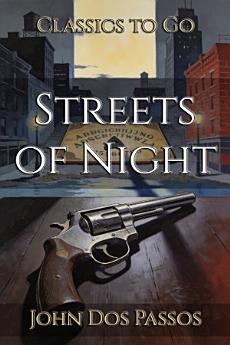
Streets of Night: Restored Classics to Go Edition
About this ebook
Discover more
About the author
John Dos Passos was an American novelist, journalist, and social critic whose life and writing were shaped by travel, war, political upheaval, and a restless curiosity about modern life. Born in 1896 and educated at Harvard, he came of age in an era of rapid industrial change and global conflict, experiences that deeply influenced his fiction and nonfiction alike. After serving as a volunteer ambulance driver during World War I, he developed a lifelong skepticism toward war, power, and the systems that shape ordinary lives. Over the course of a long career, he became one of the most inventive voices of twentieth-century American literature, known for blending narrative, documentary fragments, newsreel-style montage, and sharp social observation to capture the speed and fragmentation of modern society. His work often explores disillusionment, class struggle, political idealism, and the tension between individual freedom and mass culture, themes that still feel strikingly current in an age of media overload and public distrust. Dos Passos's legacy lies in his ability to make the American experience feel both expansive and unsettled, revealing how history presses on private lives. Readers today continue to find in him a powerful guide to the pressures of modernity, especially those interested in politically engaged fiction, experimental form, and the moral complexity of a changing world.