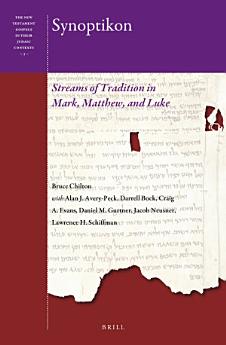
Synoptikon: Streams of Tradition in Mark, Matthew, and Luke
Oct 2022 · BRILL
Ebook
528
Pages
Tools
info
About this ebook
This Synoptikon brings together the Synoptic Gospels, freshly translated, comparing them with materials selected from previous volumes in this series. The aim is to serve commentators who engage the Gospels critically and with the awareness that a consideration of their Judaic environments is crucial. Placing the texts within that setting evokes particular streams of tradition that interacted so as to produce the Gospels. These are set out in distinctive typefaces, so that readers may assess the depth of the Synoptic tradition as well as the breadth of its development.
This Synoptikon brings together the Synoptic Gospels, freshly translated, comparing them with materials selected from previous volumes in this series. The aim is to serve commentators who engage the Gospels critically and with the awareness that a consideration of their Judaic environments is cru...
Discover more
About the author
Alan J. Avery-Peck, PhD. (1981), is Professor of Religious Studies and Kraft-Hiatt Professor of Judaic Studies at the College of the Holy Cross, Worcester, MA, USA. A specialist in early Rabbinic Judaism, he wrote the introduction and commentary to 2 Corinthians, in A.J. Levine and Marc Brettler, eds., The Jewish Annotated New Testament (2nd edition, Oxford, 2017).
Bruce Chilton, Ph.D. (1976), Cambridge University, is Bernard Iddings Bell Professor of Philosophy and Religion at Bard College. He wrote the first critical translation of the Aramaic version of Isaiah with commentary (The Isaiah Targum, 1987), as well as analyses of Jesus in his Judaic context (A Galilean Rabbi and His Bible, 1984; The Temple of Jesus, 1992; Pure Kingdom, 1996; Rabbi Jesus, 2000). Recent work includes Resurrection Logic: How Jesus’ First Followers Believed God Raised Him from the Dead (2019), and The Herods. Murder, politics, and the art of succession (2021).
Darrell Bock (Phd, Aberdeen, 1983) is Senior Research Professor of New Testament Studies and Executive Director of Cultural Engagement at Dallas Theological Seminary. He is the author and editor of several books, including technical studies on blasphemy and exaltation in Judaism and on the historical Jesus.
Craig A. Evans, Ph.D. (1983), Claremont, D.Habil. (2009), Budapest, is John Bisagno Distinguished Professor of Christian Origins at Houston Baptist University in Texas. He has published several books and articles on the historical Jesus and the use of Israel’s scriptures in the New Testament and early Christianity. These include Jesus and His Contemporaries (Brill, 2005), Jesus and the Remains of His Day (Hendrickson, 2015), and Jesus and the Manuscripts (Hendrickson, 2020).
Daniel M. Gurtner, PhD (2005), is Professor of New Testament, Gateway Seminary of the Southern Baptist Convention (USA). He has published broadly in the New Testament and Second Temple Judaism, notably the award-winning T&T Clark Encyclopedia of Second Temple Judaism edited with Loren T. Stuckenbruck (2 vols., 2020). His primary research interests lie in the gospels and their interface with the Hebrew Bible and Second Temple Judaism, as in his published dissertation, The Torn Veil: Matthew’s Exposition of the Death of Jesus (2007). He is currently writing the Word Biblical Commentary on the Gospel of Matthew.
Bruce Chilton, Ph.D. (1976), Cambridge University, is Bernard Iddings Bell Professor of Philosophy and Religion at Bard College. He wrote the first critical translation of the Aramaic version of Isaiah with commentary (The Isaiah Targum, 1987), as well as analyses of Jesus in his Judaic context (A Galilean Rabbi and His Bible, 1984; The Temple of Jesus, 1992; Pure Kingdom, 1996; Rabbi Jesus, 2000). Recent work includes Resurrection Logic: How Jesus’ First Followers Believed God Raised Him from the Dead (2019), and The Herods. Murder, politics, and the art of succession (2021).
Darrell Bock (Phd, Aberdeen, 1983) is Senior Research Professor of New Testament Studies and Executive Director of Cultural Engagement at Dallas Theological Seminary. He is the author and editor of several books, including technical studies on blasphemy and exaltation in Judaism and on the historical Jesus.
Craig A. Evans, Ph.D. (1983), Claremont, D.Habil. (2009), Budapest, is John Bisagno Distinguished Professor of Christian Origins at Houston Baptist University in Texas. He has published several books and articles on the historical Jesus and the use of Israel’s scriptures in the New Testament and early Christianity. These include Jesus and His Contemporaries (Brill, 2005), Jesus and the Remains of His Day (Hendrickson, 2015), and Jesus and the Manuscripts (Hendrickson, 2020).
Daniel M. Gurtner, PhD (2005), is Professor of New Testament, Gateway Seminary of the Southern Baptist Convention (USA). He has published broadly in the New Testament and Second Temple Judaism, notably the award-winning T&T Clark Encyclopedia of Second Temple Judaism edited with Loren T. Stuckenbruck (2 vols., 2020). His primary research interests lie in the gospels and their interface with the Hebrew Bible and Second Temple Judaism, as in his published dissertation, The Torn Veil: Matthew’s Exposition of the Death of Jesus (2007). He is currently writing the Word Biblical Commentary on the Gospel of Matthew.
Alan J. Avery-Peck, PhD. (1981), is Professor of Religious Studies and Kraft-Hiatt Professor of Judaic Studies at the College of the Holy Cross, Worcester, MA, USA. A specialist in early Rabbinic Judaism, he wrote the introduction and commentary to 2 Corinthians, in A.J. Levine and Marc Brettler,...
Rate this ebook
Tell us what you think.
Reading information
Smartphones and tablets
Install the Google Play Books app for Android and iPad/iPhone. It syncs automatically with your account and allows you to read online or offline wherever you are.
Laptops and computers
You can listen to audiobooks purchased on Google Play using your computer's web browser.
eReaders and other devices
To read on e-ink devices like Kobo eReaders, you'll need to download a file and transfer it to your device. Follow the detailed Help Center instructions to transfer the files to supported eReaders.