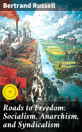
The Proposed Roads to Freedom: Socialism, Anarchism & Syndicalism
May 2022 · DigiCat
Ebook
132
Pages
family_home
Eligible
info
About this ebook
In "The Proposed Roads to Freedom," Bertrand Russell elucidates his vision for a society rooted in rationality, social justice, and individual liberty. Written in the early 1910s, amidst the backdrop of rising industrialization and burgeoning social movements, Russell employs a lucid and engaging prose style, interweaving philosophical rigor with practical considerations. The book critically examines various political ideologies, including socialism and anarchism, offering insightful critiques and proposing innovative frameworks that advocate for a more equitable society while remaining cognizant of the complexities of human behavior and societal structures. Bertrand Russell, a prominent philosopher, logician, and social critic, was deeply influenced by the socio-political climate of his time. His personal experiences, including his activism against war and advocacy for social reforms, shaped his beliefs regarding freedom and governance. Russell's interdisciplinary approach draws from his profound understanding of mathematics, philosophy, and history, making his arguments not only compelling but also relevant as he challenges readers to rethink established norms and consider alternatives to traditional state systems. "The Proposed Roads to Freedom" is an essential read for those intrigued by political philosophy and social theory. Russell's accessible yet profound insights encourage readers to engage critically with the foundations of freedom and governance, making this book a timely and valuable exploration for anyone interested in the progress of societal structures and the quest for human liberty.
In "The Proposed Roads to Freedom," Bertrand Russell elucidates his vision for a society rooted in rationality, social justice, and individual liberty. Written in the early 1910s, amidst the backdrop of rising industrialization and burgeoning social movements, Russell employs a lucid and engaging...
Discover more
About the author
Bertrand Russell, OM FRS (1872–1970), was a British philosopher, logician, essayist, and social critic, who is widely regarded as one of the most influential intellectuals of the 20th century. His profound contributions to a spectrum of disciplines, including philosophy of language, epistemology, and mathematics epitomize his towering intellectual stature. A Nobel laureate in Literature (1950) for his humanitarian ideals and freedom of thought, Russell was a quintessential figure of liberal, social, and political thought. In 'The Proposed Roads to Freedom' (1918), Russell explores the tenets of socialism, anarchism, and syndicalism, dissecting the paths that contemporary society might take to achieve social emancipation. This book reflects Russell's tireless quest for individual liberty and his deep skepticism of dogmatic systems. A co-author of 'Principia Mathematica', Russell made monumental contributions to logic and analytic philosophy, pioneering the use of logical analysis in the study of philosophical problems. Alongside his technical work in logic, Russell was also a prolific writer of popular and accessible works, where he communicated complex ideas with clarity and a distinct wry humour. Notable for his advocacy of anti-imperialism, anti-war activism, and nuclear disarmament, Russell's legacy extends into the realms of political activism and public discourse. His literary style, characterized by precision and a lack of pretentiousness, has made his writing enduringly influential and approachable to a broad readership.
Bertrand Russell, OM FRS (1872–1970), was a British philosopher, logician, essayist, and social critic, who is widely regarded as one of the most influential intellectuals of the 20th century. His profound contributions to a spectrum of disciplines, including philosophy of language, epistemology,...
Rate this ebook
Tell us what you think.
Reading information
Smartphones and tablets
Install the Google Play Books app for Android and iPad/iPhone. It syncs automatically with your account and allows you to read online or offline wherever you are.
Laptops and computers
You can listen to audiobooks purchased on Google Play using your computer's web browser.
eReaders and other devices
To read on e-ink devices like Kobo eReaders, you'll need to download a file and transfer it to your device. Follow the detailed Help Center instructions to transfer the files to supported eReaders.